Learning journey · stage 2
Why does everything fall alike?
Without air, a feather and a hammer fall equally fast. But why? Einstein’s answer turned our picture of gravity upside down. Three stations: at each one you commit to an answer first, then check it in the experiment.
Station 1 of 3
The windowless lift
In 1907 Einstein was still working at the patent office in Bern when it struck him: someone in free fall does not feel their own weight. He later called this his “happiest thought”. It grew into a thought experiment with two cabins without windows.
Station 2 of 3
The rubber sheet and Mercury
By 1915 Einstein’s answer was complete: mass curves spacetime, and bodies follow that curvature. The best-known picture of this is a rubber sheet with a heavy ball. The theory passed its first big test on a tiny puzzle in Mercury’s orbit.
Station 3 of 3
The solar eclipse of 1919
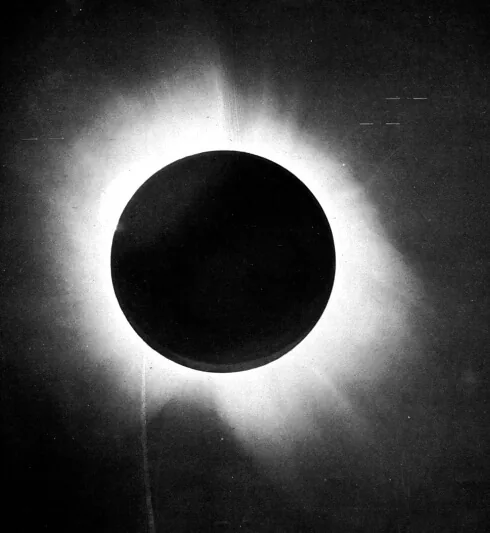
If gravity deflects light, starlight grazing past the Sun must be bent slightly. Such stars can only be seen when the Moon covers the Sun. For the total solar eclipse of 29 May 1919, the British astronomers Frank Dyson and Arthur Eddington sent out two expeditions: to the island of Príncipe off West Africa and to Sobral in Brazil.
Stars at the edge of the Sun
Einstein: 1.75″ at the Sun's edge, half as much at twice the distance.
Unmagnified (×1) the shift is invisible: 1.75″ is roughly a thousandth of the Sun's diameter. The star field is schematic, loosely based on the Hyades, not true to position. Light-blue rings: where the stars would be without the Sun.
Measured in 1919: deflection at the Sun's edge
- Sobral, 4-inch lens: 1.98″ ± 0.18″
- Príncipe: 1.61″ ± 0.30″
- Sobral, main telescope (discarded in 1919): 0.93″
- Re-measured in 1979: Sobral, 4-inch lens: 1.90″ ± 0.11″
- Re-measured in 1979: Sobral, main telescope: 1.55″ ± 0.34″
Values and error bars after Crispino & Kennefick (2019); for the Sobral main telescope the 1919 report gives no reliable error.
- Wikipedia: History of general relativity – the “happiest thought” of 1907
- Wikipedia: Equivalence principle
- Wikipedia: Apollo 15 – the hammer and the feather on the Moon
- Wikipedia: Tests of general relativity
- Wikipedia: Vulcan (hypothetical planet)
- Magdalena Kersting: Free fall in curved spacetime – how to visualise gravity in general relativity. Physics Education 54 (2019), 035008
- Wikipedia: Gravitational time dilation
- Wikipedia: Eddington experiment
- Luís C. B. Crispino, Daniel Kennefick: 100 years of the first experimental test of General Relativity. Nature Physics 15 (2019), arXiv:1907.10687