Proving ground · Bern 1902–1909
The Bern patent office
For seven years Albert Einstein examined other people’s inventions in Bern. Now it’s your turn: synchronise station clocks with light signals and reject six inventions that can never work.
Seven years at the examiner’s desk
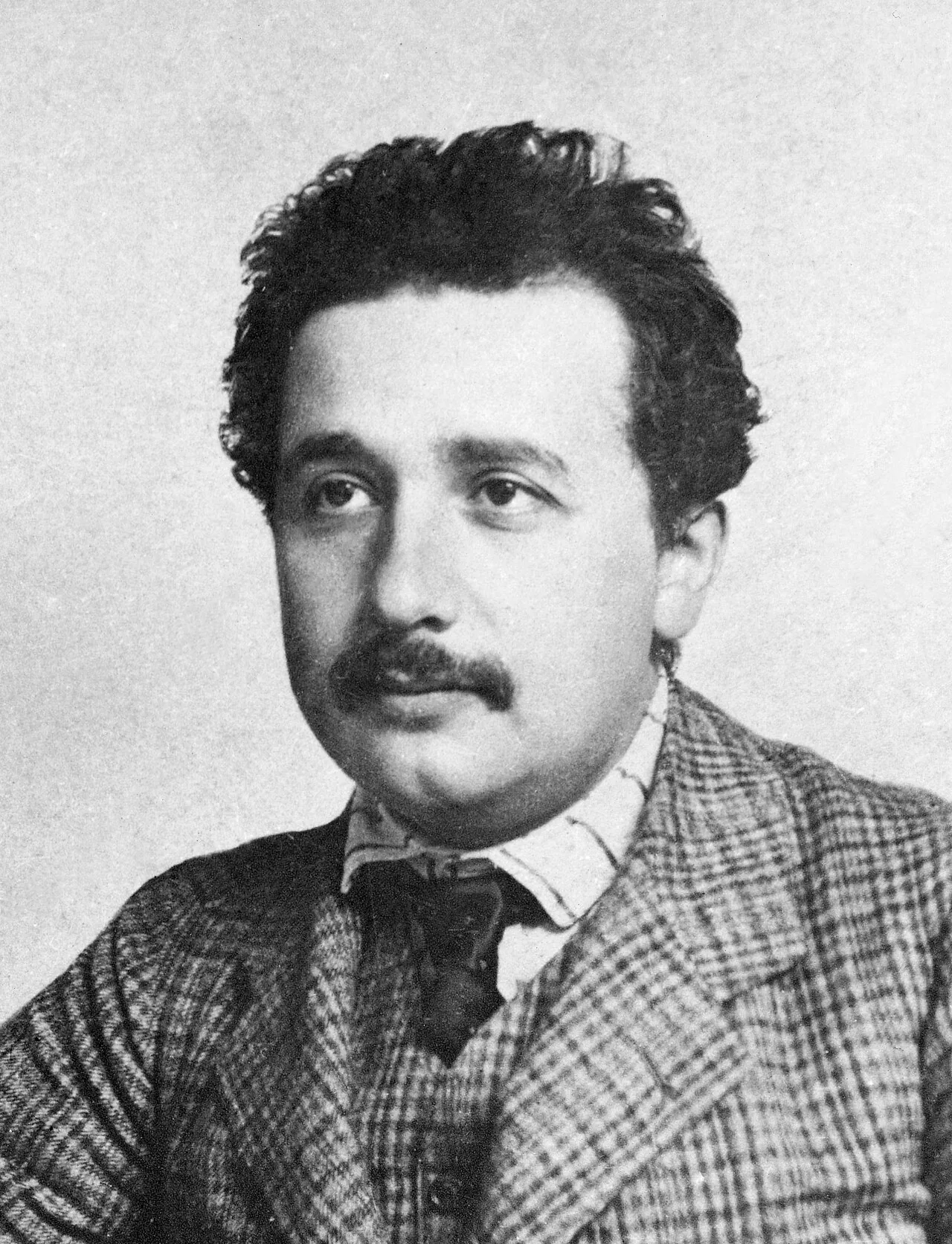
On 23 June 1902 Einstein, then 23 years old, started work at the Federal Office for Intellectual Property in Bern as a “technical expert, third class”. After his diploma he had not found a post as a university assistant; this job came through the father of his fellow student Marcel Grossmann. All kinds of patent applications landed on his desk, among them a gravel sorter and an electric typewriter.
These were the years of his miracle year of 1905. In 1907, still at the office, he had the thought he later called the happiest of his life: someone in free fall does not feel their own weight. In 1909 he left the office to become an associate professor at the University of Zurich.
- Wikipedia: Albert Einstein, section “Assistant at the Swiss Patent Office (1902–1909)”.
- Wikipedia (German): Albert Einstein, sections “Vom Hauslehrer zum Patentamt Bern” and “Die Schritte bis zur neuen Theorie der Gravitation”.
- Wikipedia: Swiss Federal Institute of Intellectual Property.
- Wikipedia: Peter Galison; P. Galison: Einstein’s Clocks, Poincaré’s Maps. Empires of Time. New York: W. W. Norton, 2003.
Thought experiment · Bern 1905
The clock game: Geneva, Bern, Zurich
What does it mean for two clocks in different places to “run together”? Einstein put exactly this question at the start of his paper on relativity. Synchronise three station clocks with a light signal. Sounds easy – but the signal itself takes time.
If I say, for example, “That train arrives here at 7 o’clock”, this means roughly: “The pointing of the small hand of my watch to 7 and the arrival of the train are simultaneous events.”Albert EinsteinZur Elektrodynamik bewegter Körper, Annalen der Physik 17 (1905), p. 893 · translated from the German
The game clocks show millionths of a second; this is about the principle, not about the clock technology of 1905. The game uses a light signal; a current in a telegraph wire would be slower, but the method would be the same.
For the curious: the working
Travel time. Light covers 299,792 km per second, just under 0.3 km per microsecond. Bern–Zurich (95.5 km as the crow flies): 95.5 ÷ 0.2998 ≈ 318.6 µs. Bern–Geneva (129.5 km): ≈ 432.0 µs. The three cities lie almost on one line; the game treats it as straight.
Einstein’s rule (1905). A light signal leaves A at A-time tA, is reflected at B at B-time tB, and is back at A at A-time t′A. The clocks are synchronous if tB − tA = t′A − tB. So B has to be set to tA plus half the round-trip time.
From the train. The train moves at v = β·c. By the Lorentz transformation, train time is t′ = γ·(t − v·x/c²). All events that are simultaneous for the train with “train at Bern” (x = 0, t = 0) have t′ = 0, so t = v·x/c² = β·(x/c). At β = 0.6 the Zurich clock (x/c ≈ 318.56 µs) then shows 0.6 · 318.56 ≈ 191.1 µs more than Bern, the Geneva clock 0.6 · 431.96 ≈ 259.2 µs less. At the same time the line is shorter for the train by a factor γ = 1.25.
And a real train? At 100 km/h the “now” between Bern and Zurich shifts by only about 30 trillionths of a second. That is why nobody notices it in everyday life.
- A. Einstein: Zur Elektrodynamik bewegter Körper, Annalen der Physik 17 (1905), § 1 “Definition der Gleichzeitigkeit” (Wikisource, German).
- Wikipedia: Einstein synchronisation; Wikipedia: Relativity of simultaneity.
- Distances: straight-line distances from the coordinates of the three cities (haversine formula), rounded.
Examination
Six files on the desk
The following patent applications are made up, and so are the names and dates. The laws of nature they fail on are real. Find the part that cannot work like this, name the principle it breaks, and stamp the file. Only your browser remembers which files you have already rejected.
- Wikipedia: Speed of sound (in steel about 6,000 m/s).
- A. Einstein: Zur Elektrodynamik bewegter Körper, Annalen der Physik 17 (1905), § 2 (principle of the constancy of the speed of light; Wikisource, German); Wikipedia: Emission theory (relativity), tests of source independence, including Alväger et al. 1964.
- Wikipedia: Gravitational shielding; Wikipedia: Equivalence principle; Wikipedia: The First Men in the Moon (H. G. Wells, 1901).
- Wikipedia: Work function (zinc 3.63–4.9 eV); Wikipedia: Photoelectric effect; Nobelprize.org: The Nobel Prize in Physics 1921.
- Wikipedia: Perpetual motion; Wikipedia: Perpetual motion, section “Patents”.