Chapter 05 · The Science

General Relativity

Special relativity left gravity untouched. It took Einstein another decade — and the hardest mathematics of his life — to finish the job. The result, completed in 1915, is widely regarded as the most beautiful theory in all of physics: gravity is not a force pulling across space, but the bending of spacetime itself.

"The happiest thought of my life"

In 1907, daydreaming at the patent office, Einstein realised something simple and profound: a person in free fall does not feel their own weight. A man falling from a roof, an astronaut in orbit, coins dropped in a falling lift — all float as if gravity had switched off.

This equivalence principle — that gravity and acceleration are locally indistinguishable — was his key. If gravity can be made to vanish just by falling, then perhaps gravity is not a force at all, but something about the geometry of space and time.

If a person falls freely, he will not feel his own weight.Albert Einsteinrecalled in his Kyoto lecture, 14 December 1922 (the thought dates from 1907; translated from the Japanese notes)

You can play this through as a thought experiment. Picture a windowless cabin standing on Earth: a ball you let go falls to the floor at 9.81 m/s². Now put the same cabin far from any star and let a rocket push it with exactly that acceleration: the floor rushes up to meet the ball, and from inside it looks just the same. Drop the ball, switch on the light, and only then open the windows.

Your prediction

Cabin B is accelerated upwards at 1 g by a rocket in empty space. A light beam crosses the cabin horizontally. What does its path look like from the inside?

Interactive · equivalence principle

Two cabins, one result

Windows closed: from inside, both cabins look the same.

Greatly exaggerated: in a cabin 2 m wide, at 1 g the beam drops only about 2 × 10⁻¹⁶ m, because light needs just some 7 billionths of a second to cross it.

Answer

BVery slightly curved downwards.

While the light crosses the cabin, the floor accelerates upwards towards it. Seen from the inside, the beam therefore sinks on a slightly bent path – in a cabin 2 m wide by only about 2 · 10⁻¹⁶ m. In 1907 Einstein concluded: because acceleration and gravity cannot be told apart inside a windowless cabin (the equivalence principle), Earth’s gravity must also bend a light beam downwards.

For the curious: the calculation

Light needs t = 2 m / (3 · 10⁸ m/s) ≈ 6.7 · 10⁻⁹ s to cross 2 m. In that time the floor moves ½ · g · t² = ½ · 9.81 m/s² · (6.7 · 10⁻⁹ s)² ≈ 2.2 · 10⁻¹⁶ m – that is how far the beam sinks relative to the cabin.

Source: Wikipedia: Equivalence principle

Challenges0 of 3 done

  • Let go of the ball and compare the two cabins.open
  • Switch on the light: does the beam bend the same way in both cabins?open
  • Open the windows and see which cabin is standing on Earth.open

Embed this interactive experiment on your webpage

Copy the HTML code below to embed this interactive experiment on your own webpage:

The real surprise is the light beam. In the rocket it is easy to see why it bends: while the light crosses the cabin, the floor moves upward ever faster. But if no experiment can tell the two cabins apart, the beam must bend on Earth as well. From this Einstein concluded in 1911 that gravity deflects light; the correct amount, twice what he had calculated then, came out of the finished theory in 1915.

Sources:
  1. Wikipedia: General relativity.
  2. Wikipedia: Equivalence principle.
  3. Wikipedia: Tests of general relativity — Einstein's 1911 value from the equivalence principle alone, and the doubled value of 1915.
  4. Own calculation for the cabin: drop = ½ · g · (L/c)² with L = 2 m, g = 9.81 m/s², c = 299,792,458 m/s, giving about 2 × 10⁻¹⁶ m.

Matter tells spacetime how to curve

The picture general relativity gives us is this: mass and energy warp the spacetime around them, like a heavy ball denting a stretched rubber sheet. Other objects — planets, light, you — simply follow the straightest possible paths through that curved geometry. What we feel as the "force" of gravity is really the curvature of spacetime guiding our motion.

He did not do it alone. His old classmate Marcel Grossmann introduced him to the non-Euclidean geometry of Riemann and the tensor calculus he needed. In the final weeks of 1915, Einstein raced the great mathematician David Hilbert to the finish — and arrived, exhausted and triumphant, at the equations that bear his name.

In the model below, spacetime is a stretched sheet. The heavier the ball in the middle, the deeper the dent, and a small test ball pushed sideways runs on a path around it: if it is very slow it plunges in, if it is too fast it escapes. Set the mass, move the heavy ball with a click or the arrow keys, and launch the test ball.

Your prediction

How fast must the test ball be pushed to escape from the dent – compared with the speed it needs for a circular orbit?

Interactive · spacetime as a rubber sheet

The dent in the sheet

Set the mass and launch the test ball.

The test ball moves according to Newton's law of gravitation; the depth of the dent is drawn for illustration only. Click or tap to put the heavy ball somewhere else.

What the rubber sheet doesn’t tell you

1 · It explains gravity with gravity

The heavy ball only presses the dent in because the Earth pulls it down, and the small ball only rolls in for the same reason. Take the Earth away from under the sheet and see what is left of the model.

2 · What really pulls: curved time

In Einstein’s theory, clocks close to a mass run more slowly. On Earth the effect is tiny: a clock one metre higher runs faster by 1.1 × 10⁻¹⁶, about 3.4 billionths of a second per year. In 2010, atomic clocks measured it for a height difference of just 33 centimetres.

ground 50 m 100 m

Animation: 100 m of height, the difference in rate exaggerated about five trillion times.

So over 80 years the head of a person 1.70 m tall ages about half a millionth of a second more than their feet.

3 · The path through spacetime

Throw a ball straight up: after 2 seconds it is back down. In a picture of height against time its path is an arch. According to Einstein, a body flying freely between throw and landing takes the path on which its own clock shows the most time. Clocks run faster higher up, so it pays to fly upward. But going too high means flying faster, and fast clocks run slower. Try out different arches.

0510 012 height (m) time (s) lying still
+2.32 · 10−16 s
extra time on the ball’s clock compared with lying still on the ground

Too low: going a little higher would gain the clock more than the faster flight costs.

For slow bodies – balls, planets, you – gravity comes almost entirely from curved time. The curvature of space, which the sheet shows, is much weaker for them – it only shows up in subtle effects such as Mercury’s 43″. Light, however, feels both in equal parts. That is why Einstein’s deflection of light (1.75″) is twice Newton’s (0.87″).

For the curious: the calculation
  • Rate difference of two clocks whose heights differ by h: Δf/f ≈ g·h/c² = 9.81 m/s² · 1 m / (2.998 · 108 m/s)² ≈ 1.09 · 10−16; over a year (3.16 · 107 s) that is 3.4 · 10−9 s.
  • Time on a clock along a path h(t), for slow motion in a weak field: τ ≈ ∫ (1 + g·h/c² − v²/(2c²)) dt.
  • For arches h(t) = k·t·(T − t) with T = 2 s, the gain over lying still is Δτ = T³/6 · (g·k − k²)/c². It is largest for k = g/2: exactly a throw that falls with g, peak height g·T²/8 = 4.9 m, gain 3.6 · 10−16 s.
  • Light deflection: the warping of time alone gives 0.87″, the warping of space adds the same amount again, 1.75″ in total.
Sources:
  1. NIST (2010): aluminium atomic clocks show the effect for a height difference of 33 cm; Chou et al., “Optical Clocks and Relativity”, Science 329, 1630–1633 (2010).
  2. Wikipedia: Gravitational time dilation.
  3. Carroll, Lecture Notes on General Relativity, arXiv:gr-qc/9712019: only the time part of the geometry matters for slow bodies (Newtonian limit, ch. 4).
  4. Wikipedia: Geodesics in general relativity: a free-fall path is the one with the longest proper time between nearby paths; Taylor & Wheeler, Exploring Black Holes (2000): principle of maximal aging.
  5. Will, “The Confrontation between General Relativity and Experiment”, Living Rev. Relativ. 17, 4 (2014), arXiv:1403.7377: light deflection (1 + γ)/2 · 1.75″, γ measures the curvature of space.
  6. Own calculation of the clock rates and of the arch; see “For the curious”.
Answer

BFrom about 1.4 times as fast.

From about 1.4 times the circular speed (exactly √2 times) the energy of motion is enough to leave the dent. Below that the ball runs on ellipses, at 100 % almost in a circle, and with very little speed it falls in. The orbits here are calculated with Newton’s law, the dent is only a picture. In Einstein’s theory a mass curves space and time, and for slow bodies such as planets most of the effect comes from the curving of time. No sheet can show that.

For the curious: the calculation

Circular orbit: v = √(GM / r). Escape: energy of motion ≥ binding energy, ½ v² ≥ GM / r, so v ≥ √(2GM / r) = √2 · √(GM / r) ≈ 1.41 times the circular speed.

Source: Wikipedia: Escape velocity

Challenges0 of 3 done

  • Put the test ball on an almost circular orbit.open
  • Push the test ball so fast that it escapes from the dent.open
  • Take the mass away completely: what does the test ball do now?open

Embed this interactive experiment on your webpage

Copy the HTML code below to embed this interactive experiment on your own webpage:

The rubber sheet is only an analogy, though, and it has well-known weaknesses. The balls roll inward only because Earth's gravity pulls them down, so the picture explains gravity with gravity. And the warping of time, which is essential to gravity here on Earth, is missing from it entirely.

Sources:
  1. Wikipedia: Einstein field equations.
  2. Wikipedia: Marcel Grossmann.
  3. Kaur, Blair et al., “Teaching the Einsteinian gravity paradigm” (2017), arXiv:1703.00164 — the limitations of the stretched-sheet model.

The eclipse that made him famous

A theory is only as good as its predictions. General relativity made a daring one: gravity should bend light. Starlight grazing the Sun should be deflected by about 1.75 arc-seconds — twice the amount old Newtonian physics allowed.

You cannot see stars next to the Sun… except during a total eclipse. On 29 May 1919, two expeditions organised by Frank Dyson and Arthur Eddington photographed an eclipse — Eddington himself from Príncipe (off West Africa), Andrew Crommelin and Charles Davidson from Sobral (Brazil). The stars had moved. Einstein was right.

When the results were announced in November 1919, the world's press erupted. The Times of London declared a "Revolution in Science." Overnight, Albert Einstein became the most famous scientist on Earth — a global celebrity in a way no physicist had ever been.

How tiny the effect is becomes clear in the model below. Stars surround the darkened Sun; according to Einstein, light that just grazes the Sun's edge is bent by 1.75 arc-seconds, and at twice the distance by only half as much, because the deflection falls off with distance. The Sun acts as a weak gravitational lens: the stars appear slightly farther from it than they really are. Switch between “No gravity”, “Newton” and “Einstein”, and set how strongly the shift is magnified.

Your prediction

How far do stars at the edge of the Sun appear to be shifted? Einstein’s prediction of 1915, compared with the value that follows from Newton’s theory:

Interactive · solar eclipse of 1919

Stars at the edge of the Sun

Einstein: 1.75″ at the Sun's edge, half as much at twice the distance.

Unmagnified (×1) the shift is invisible: 1.75″ is roughly a thousandth of the Sun's diameter. The star field is schematic, loosely based on the Hyades, not true to position. Light-blue rings: where the stars would be without the Sun.

Measured in 1919: deflection at the Sun's edge

Newton 0.87″ Einstein 1.75″
  • Sobral, 4-inch lens: 1.98″ ± 0.18″
  • Príncipe: 1.61″ ± 0.30″
  • Sobral, main telescope (discarded in 1919): 0.93″
  • Re-measured in 1979: Sobral, 4-inch lens: 1.90″ ± 0.11″
  • Re-measured in 1979: Sobral, main telescope: 1.55″ ± 0.34″

Values and error bars after Crispino & Kennefick (2019); for the Sobral main telescope the 1919 report gives no reliable error.
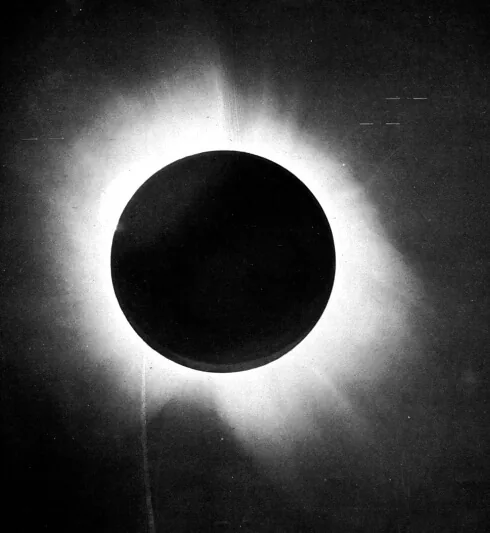
Photographic plate of the total solar eclipse of 29 May 1919, used to confirm general relativity
One of Eddington's 1919 eclipse plates. Stars near the darkened Sun appeared shifted — light bent by the Sun's gravity, exactly as Einstein predicted.Image: F. W. Dyson, A. S. Eddington & C. Davidson. Public domain, via Wikimedia Commons (Source)
Answer

BTwice as large.

Einstein predicted 1.75″ at the edge of the Sun; Newton’s theory gives 0.87″ – exactly half. The difference arises because in Einstein’s theory not only time but also space is curved, and both contribute about equally. The two 1919 series of measurements on which the result rested gave about 1.6″ and 2.0″ – closer to Einstein. A new measurement of the photographic plates in 1979 confirmed this.

For the curious: the calculation

Einstein: deflection at the edge of the Sun α = 4GM / (c²R) ≈ 1.75″. Newton (light as particles): 2GM / (c²R) ≈ 0.87″. At twice the distance from the centre of the Sun, the deflection is half as large in each case.

Source: Wikipedia: Tests of general relativity

Challenges0 of 2 done

  • Select Newton’s prediction and compare how far the stars move now.open
  • Set the magnification to ×1: this is how small the shift really is.open

Embed this interactive experiment on your webpage

Copy the HTML code below to embed this interactive experiment on your own webpage:

How accurate the 1919 measurement really was has long been debated. The blurred images from the main telescope at Sobral gave only 0.93 arc-seconds and were discarded; in 1980 the philosophers Earman and Glymour saw this as possible bias in Einstein's favour. Yet as early as 1979, a re-measurement of the Sobral plates with a modern measuring machine had supported Eddington's result, though it went unnoticed for a long time. Radio astronomy settled the question: since the late 1960s, radio telescopes have measured the deflection on distant radio sources such as quasars, with no eclipse needed, and today VLBI measurements confirm Einstein's value to about 0.03 percent.

Sources:
  1. Wikipedia: Eddington experiment.
  2. Dyson, Eddington & Davidson, Phil. Trans. R. Soc. (1920).
  3. Crispino & Kennefick, “A hundred years of the first experimental test of general relativity”, Nature Physics 15, 416–419 (2019), arXiv:1907.10687 — the 1919 values and the 1979 re-measurement.
  4. Kennefick, “Not Only Because of Theory: Dyson, Eddington and the Competing Myths of the 1919 Eclipse Expedition”, arXiv:0709.0685 — the Hyades, the 1980 criticism, the overlooked 1979 re-analysis.
  5. Wikipedia: Gravitational lens — deflection angle θ = 4GM/(c²r), i.e. proportional to 1/distance; Angular diameter — the Sun appears 31′27″ to 32′32″ across.
  6. Wikipedia: Eddington experiment — radio measurements of the late 1960s; Tests of general relativity — VLBI to about 0.03 %.

Interactive · measuring the 1919 plates

Eddington’s light table

This is how the measurement was done in 1919: the photographic plate taken during the eclipse was laid on a comparison plate of the same star field, taken at night without the Sun. Then a micrometer measured how far apart each star lay on the two plates.

1 · Lay the eclipse plate (gold) on the night plate (blue) so that the stars far from the Sun coincide. Drag it, use the arrow keys, or press the button.

1234567 Night plate, without the Sun Eclipse, 29 May 1919

The two plates are still out of line.

2 · Pick stars close to the Sun and read off how far they have moved outward.

Magnifier

Choose a star.

Comparison: deflection at the Sun’s edge

Newton 0.87″ Einstein 1.75″
  • Sobral 1919, 4-inch lens: 1.98″ ± 0.18″
  • Príncipe 1919: 1.61″ ± 0.30″
  • Your value: —

At Sobral the comparison plates were taken on the spot in July 1919; for Príncipe they had been taken in Oxford before the expedition left. The real plates showed only a few stars each, seven on the best ones from Sobral.

Schematic: the star field, the positions of the stars and the small measuring errors are invented, loosely based on the Hyades. The shift is drawn magnified 500 times; unmagnified, 1.75″ would be less than a thousandth of the Sun’s diameter.

For the curious: the calculation

The deflection falls off with distance: θ = 1.75″ · R/r (R = radius of the Sun, r = distance from its centre). A star at 2.5 R therefore moves by 1.75″ / 2.5 = 0.70″. Conversely, every reading is scaled up to the edge: θedge = θ · r/R. Your value is the average of these scaled-up readings. Newton’s physics, treating light as tiny particles, gives half as much: 0.87″.

Sources:
  1. Kennefick, “Not Only Because of Theory: Dyson, Eddington and the Competing Myths of the 1919 Eclipse Expedition”, arXiv:0709.0685: the plates were clipped together face to face and the separation of each star measured with a micrometer.
  2. Crispino & Kennefick, Nature Physics 15, 416–419 (2019), arXiv:1907.10687: the values 1.98 ± 0.18″ (Sobral, 4-inch lens) and 1.61 ± 0.30″ (Príncipe); comparison plates at Sobral in July 1919, for Príncipe in Oxford.
  3. Wikipedia: Eddington experiment: Hyades, comparison plates taken months apart at night, seven stars on the Sobral 4-inch plates.
  4. Wikipedia: Gravitational lens: deflection proportional to 1/distance; Dyson, Eddington & Davidson, Phil. Trans. R. Soc. A 220, 291–333 (1920).

Predictions that keep coming true

A century on, general relativity has passed every test — often ones Einstein never lived to see.

Mercury's orbit

A tiny, century-old anomaly in Mercury's orbit — 43 arc-seconds per century — that Newton could not explain fell out of Einstein's equations exactly. This was his first triumph.

Gravitational lensing

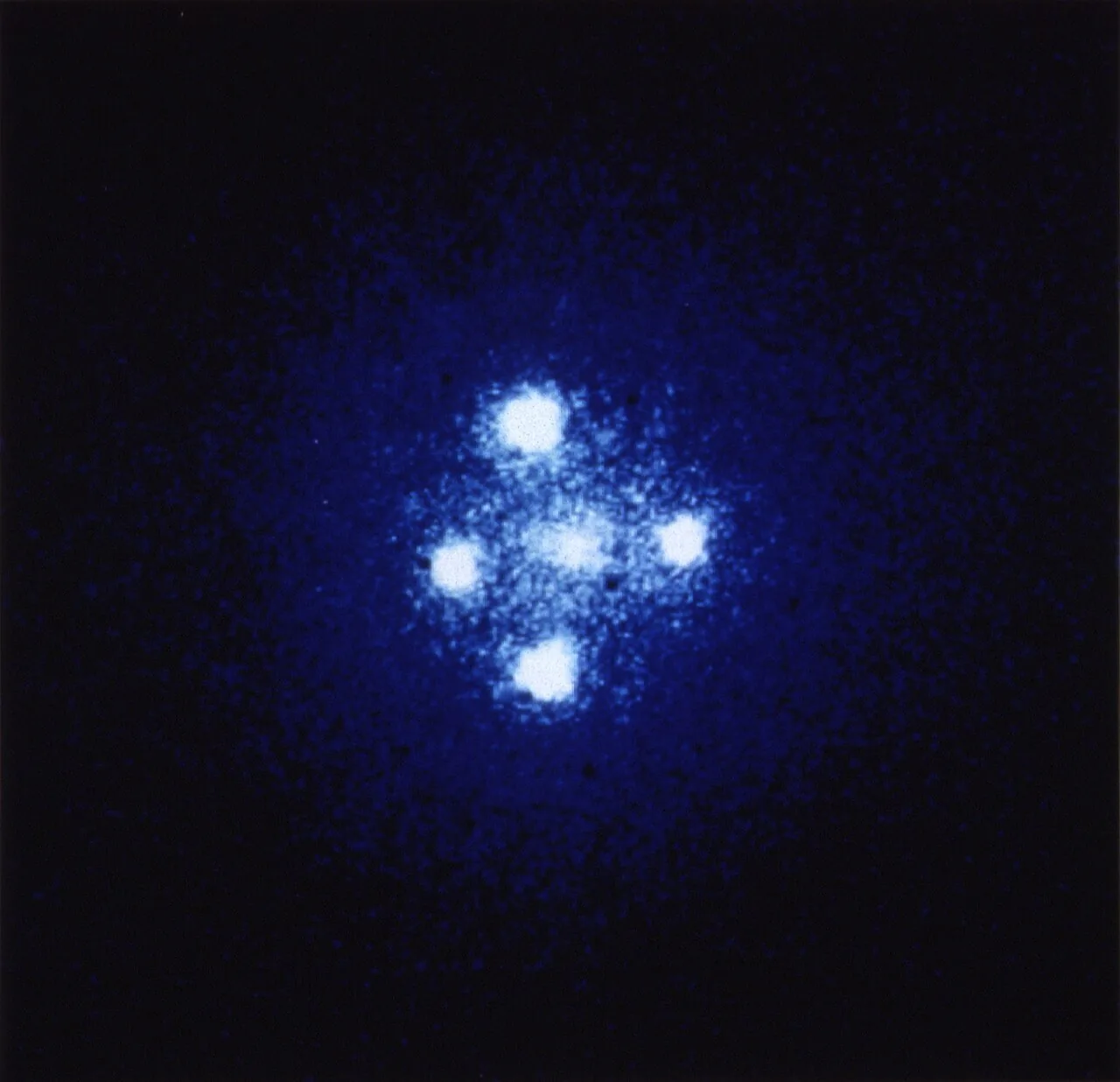
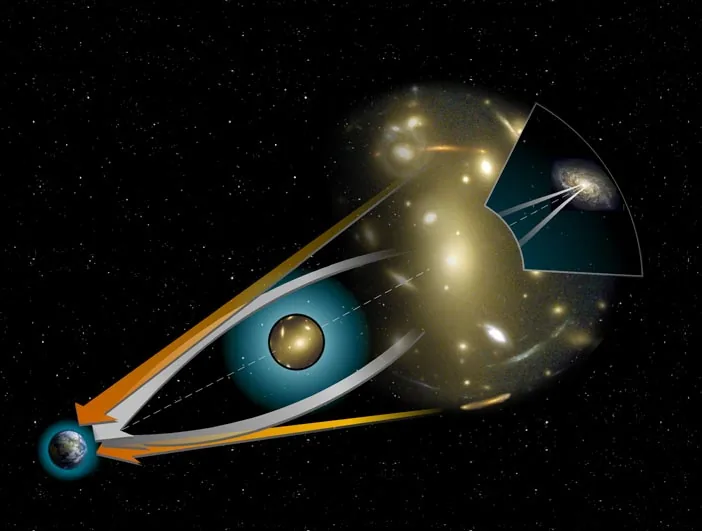
Massive galaxies bend the light of objects behind them into arcs and multiple images — gravity acting as a cosmic lens, now a routine tool of astronomy.

Black holes

Regions where spacetime curves so steeply that not even light escapes. First imaged in 2019 — a prediction Einstein found troubling.

Gravitational waves

Ripples in spacetime from colliding black holes. Predicted in 1916, detected by LIGO in 2015 — about a century later.

Mercury's orbit is an ellipse whose point closest to the Sun, the perihelion, slowly swings around the Sun: by about 575 arc-seconds per century. Some 532 of them come from the pull of Venus, Jupiter, Earth and the other planets, and Newton's physics explains those. The remaining 43 had been a puzzle ever since Urbain Le Verrier noticed in 1859 that Mercury's orbit did not fit Newton's theory (his figure of 38 arc-seconds was later refined to 43), until Einstein calculated them from his new theory on 18 November 1915. Let time run and switch Einstein's correction on and off.
Your prediction

Mercury’s orbital ellipse turns by about 43 arcseconds per century more than Newton’s theory explains. 3,600 arcseconds make one degree. How long does it take for this remainder to add up to one degree?

Interactive · Mercury's perihelion

The ellipse that turns

0″
left over that Newton cannot explain
42.98″
per century: Einstein's share

Observed turning: about 575″ per century

532″ pull of the other planets (Newton)43″ Einstein

Greatly exaggerated: the ellipse is drawn far more elongated than Mercury's real orbit, and the turning is magnified 25 times. The 532″ caused by the planets are subtracted; what you see is only the remaining 43″ per century. The dot does not move at its real pace.

Answer

BAbout 8,400 years.

3,600″ divided by 43″ per century is about 84 centuries, roughly 8,400 years. The effect is tiny, yet Urbain Le Verrier had already recognised it as a puzzle in 1859. Einstein’s general theory of relativity explained exactly this remainder in 1915.

For the curious: the calculation

3,600″ / 42.98″ per century ≈ 83.8 centuries ≈ 8,380 years.

Source: Wikipedia: Tests of general relativity

Challenges0 of 3 done

  • Let enough time pass for Newton’s remainder to grow to about one degree.open
  • Include Einstein’s correction: do prediction and observation now match?open
  • Let time run to the end: 3,000 centuries.open

Embed this interactive experiment on your webpage

Copy the HTML code below to embed this interactive experiment on your own webpage:

The Einstein Cross: a distant quasar lensed into four images by a foreground galaxy
The "Einstein Cross": one distant quasar, split into four images by the gravity of a galaxy in front of it — gravitational lensing, predicted by relativity.Image: NASA, ESA & STScI. Public domain, via Wikimedia Commons (Source)
Illustration of gravitational lensing, light bending around a massive object
How it works: light from a distant source bends as it passes a massive object, distorting and multiplying its image.Image: NASA / ESA. Public domain, via Wikimedia Commons (Source)
Sources:
  1. Wikipedia: Tests of general relativity.
  2. Gravitational waves; gravitational lensing.
  3. Images: NASA/ESA/STScI, public domain, via Wikimedia Commons.
  4. Park et al., “Precession of Mercury's Perihelion from Ranging to the MESSENGER Spacecraft”, The Astronomical Journal 153, 121 (2017), doi:10.3847/1538-3881/aa5be2 — 532″ from the planets, 42.98″ from general relativity, 575.3″ per century in total.
  5. Einstein, “Erklärung der Perihelbewegung des Merkur aus der allgemeinen Relativitätstheorie”, Sitzungsberichte der Preußischen Akademie der Wissenschaften, 18 November 1915, pp. 831–839 (CERN Document Server); Le Verrier 1859: Wikipedia.