Chapter 11 · Fame & Legacy
The Letter & the Bomb
It is one of history's heaviest ironies: the gentle pacifist whose equation explained nuclear energy put his name to the letter that helped start the race for the atomic bomb. Einstein neither built the weapon nor wanted it — and he spent his last decade trying to undo what he had helped set in motion.
August 1939: a warning to the President
In the summer of 1939, the physicist Leó Szilárd understood that recently discovered nuclear fission could, in principle, be turned into a bomb of terrifying power — and feared Nazi Germany was already exploring it. Szilárd needed someone whose voice the President could not ignore. He turned to his old friend Einstein.
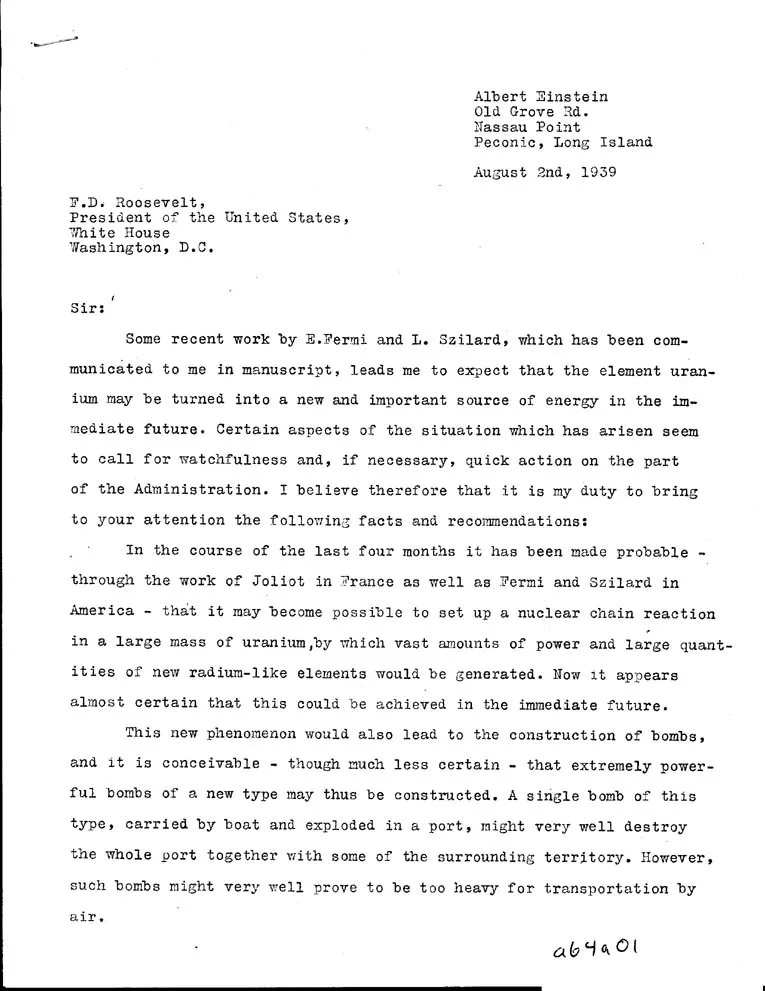
A letter dated 2 August 1939 — drafted largely by Szilárd and signed by Einstein — went to President Franklin D. Roosevelt. It warned that "extremely powerful bombs of a new type" might be possible, and urged the United States to secure uranium and accelerate research. It was, arguably, the key stimulus for the first US government uranium research, which later grew into the Manhattan Project.
The letter in full
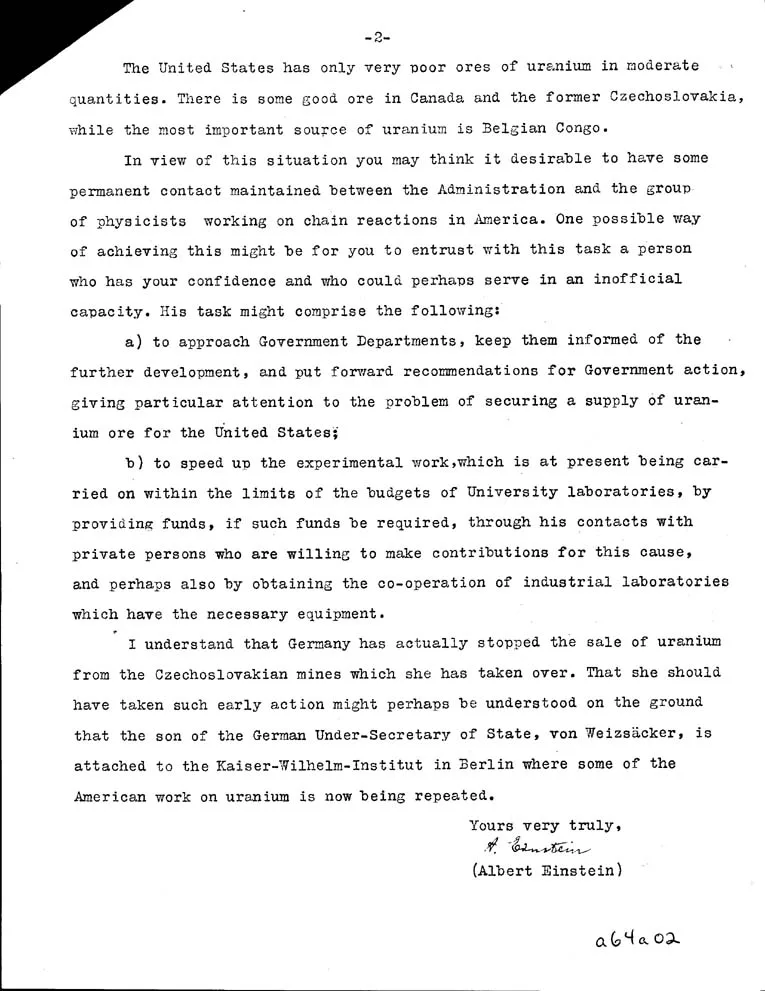
Both pages of the original from the Franklin D. Roosevelt Library, next to a complete transcript. Marked passages open a note; the passage is then highlighted on the facsimile.
Original text
Albert Einstein
Old Grove Rd.
Nassau Point
Peconic, Long Island
August 2nd, 19391
F.D. Roosevelt,
President of the United States,
White House
Washington, D.C.
Sir:
Some recent work by E.Fermi and L. Szilard2, which has been communicated to me in manuscript, leads me to expect that the element uranium may be turned into a new and important source of energy in the immediate future. Certain aspects of the situation which has arisen seem to call for watchfulness and, if necessary, quick action on the part of the Administration. I believe therefore that it is my duty to bring to your attention the following facts and recommendations:
In the course of the last four months it has been made probable - through the work of Joliot in France3 as well as Fermi and Szilard in America - that it may become possible to set up a nuclear chain reaction in a large mass of uranium,by which vast amounts of power and large quantities of new radium-like elements would be generated. Now it appears almost certain that this could be achieved in the immediate future.
This new phenomenon would also lead to the construction of bombs, and it is conceivable - though much less certain - that extremely powerful bombs of a new type4 may thus be constructed. A single bomb of this type, carried by boat and exploded in a port, might very well destroy the whole port together with some of the surrounding territory. However, such bombs might very well prove to be too heavy for transportation by air4.
Page 2
The United States has only very poor ores of uranium in moderate quantities. There is some good ore in Canada and the former Czechoslovakia, while the most important source of uranium is Belgian Congo5.
In view of this situation you may think it desirable to have some permanent contact maintained between the Administration and the group of physicists working on chain reactions in America. One possible way of achieving this might be for you to entrust with this task a person who has your confidence8 and who could perhaps serve in an inofficial capacity. His task might comprise the following:
a) to approach Government Departments, keep them informed of the further development, and put forward recommendations for Government action, giving particular attention to the problem of securing a supply of uranium ore for the United States;
b) to speed up the experimental work,which is at present being carried on within the limits of the budgets of University laboratories, by providing funds, if such funds be required, through his contacts with private persons who are willing to make contributions for this cause, and perhaps also by obtaining the co-operation of industrial laboratories which have the necessary equipment.
I understand that Germany has actually stopped the sale of uranium from the Czechoslovakian mines which she has taken over6. That she should have taken such early action might perhaps be understood on the ground that the son of the German Under-Secretary of State, von Weizsäcker7, is attached to the Kaiser-Wilhelm-Institut in Berlin7 where some of the American work on uranium is now being repeated.
Yours very truly,
[signed: A. Einstein]
(Albert Einstein)
Transcribed from the scan: words split at line ends are joined; the original spellings are kept (e.g. “E.Fermi”, “inofficial”, “co-operation”).
He was kept out of the project he started
Here is the twist that surprises most people: Einstein never worked on the Manhattan Project. In 1940 the US Army and Vannevar Bush considered the famous pacifist a security risk and denied him the clearance needed. The man whose letter helped launch the bomb was deliberately kept in the dark about it.
Hiroshima and Einstein's regret
When the bombs fell on Hiroshima and Nagasaki in August 1945, Einstein was heartbroken. He had signed the letter believing Germany might win a nuclear race; Germany had in fact never come close, and the weapon was used instead against Japan. He came to regard his signature as a grave error: in 1954 he told Linus Pauling, “I made one great mistake in my life — when I signed the letter to President Roosevelt recommending that atom bombs be made; but there was some justification — the danger that the Germans would make them.” (Pauling's note of 16 November 1954.)
Had I known that the Germans would not succeed in producing an atomic bomb, I would not have lifted a finger.Albert Einsteinas reported in Newsweek, 10 March 1947
In his final years he became a leading voice against nuclear weapons. Days before his death in 1955 he signed the Russell–Einstein Manifesto, a passionate appeal — drafted by the philosopher Bertrand Russell and signed by Einstein and others — urging humanity to renounce war in the nuclear age. It was, in a sense, his last word to the world, and it launched the Pugwash movement of scientists for peace.
Remember your humanity, and forget the rest.The Russell–Einstein Manifesto9 July 1955
- Wikipedia: Russell–Einstein Manifesto.
- Otto Nathan & Heinz Norden (eds.), Einstein on Peace (1960).
- Statements and quotations of 1947 and 1954: Wikiquote: Albert Einstein (Newsweek, 10 March 1947; Linus Pauling, note of 16 November 1954 — second-hand records).