Chapter 06 · The Science
Quanta & the Great Debate
Here is the great irony of Einstein's life. He was one of the founders of quantum theory — it won him his Nobel Prize — yet he could never accept the strange, probabilistic world it revealed. For thirty years he argued with it, and lost most of the arguments. But his objections were so deep that they are still shaping physics today.
The man who made light grainy
In his 1905 paper on the photoelectric effect, Einstein proposed that light is not a smooth wave but a stream of discrete energy packets — quanta, later called photons. Each photon's energy depends only on the light's frequency (its colour), not its brightness: E = hf.
This explained a puzzle no wave theory could: why dim blue light can knock electrons out of a metal while bright red light cannot. It was, in his own words, "very revolutionary" — and it earned him the 1921 Nobel Prize.
Try it yourself
The photoelectric effect
Shine light on a metal. Below a certain frequency, nothing happens, no matter how bright. Above it, electrons fly off instantly. Slide the colour from red toward ultraviolet and find the threshold.
- Wikipedia: Photoelectric effect — work function and threshold frequency.
More quantum gifts
Einstein's quantum contributions went far beyond 1905.
Lasers
In 1916 he described stimulated emission — one photon triggering another identical one. Decades later this became the principle behind every laser.
Bose–Einstein condensate
With Satyendra Nath Bose he predicted a strange new state of matter near absolute zero. It was finally created in a lab in 1995, winning its makers a Nobel Prize.
Wave–particle duality
His work helped reveal that light, and matter, behave as both wave and particle — a cornerstone of modern physics.
"God does not play dice"
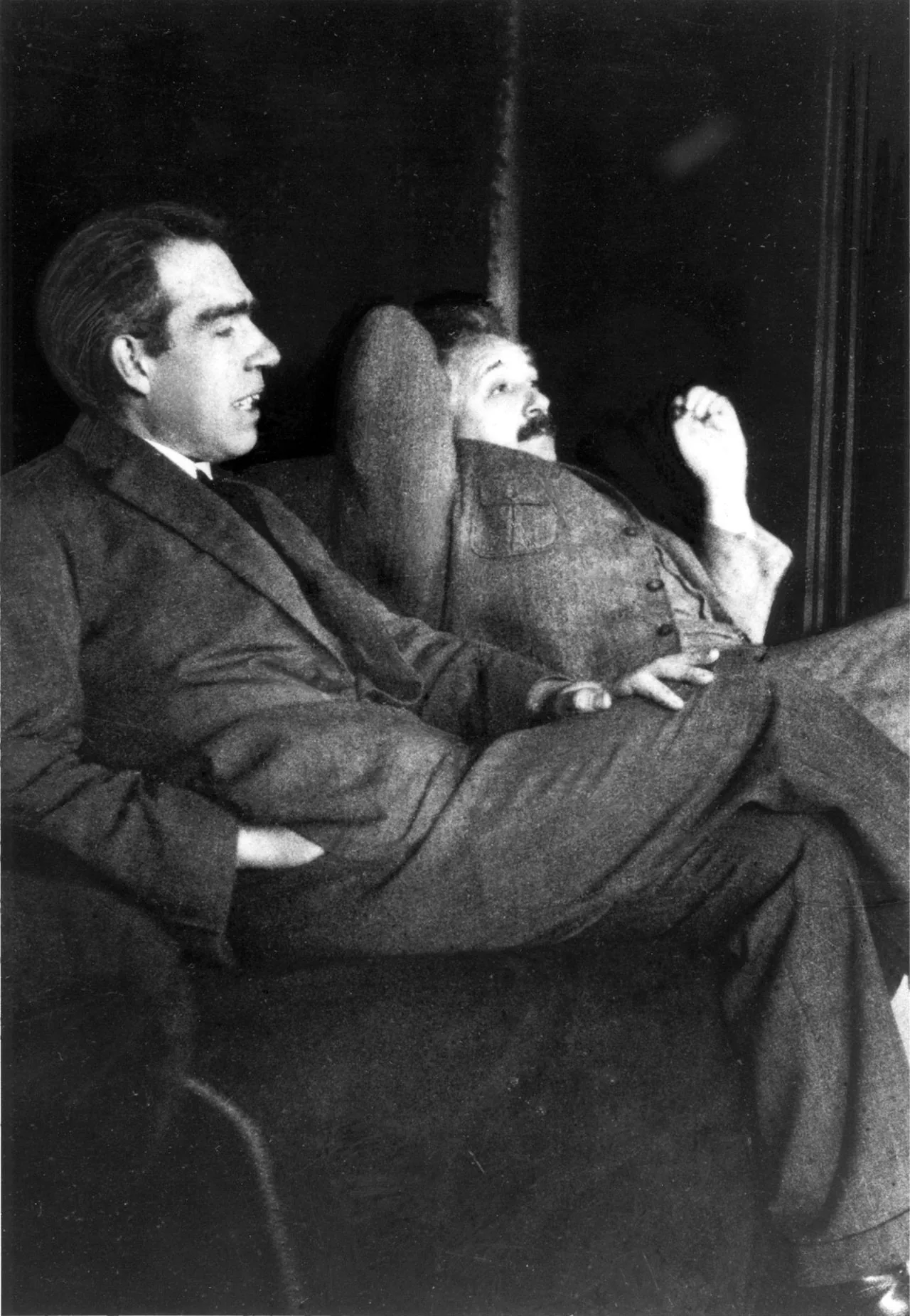
By the late 1920s, quantum mechanics had become deeply probabilistic: it could predict the odds of where an electron would be found, but never a definite answer. To Einstein this was intolerable. He believed a complete theory must describe a definite reality, not just probabilities.
At the famous Solvay Conferences he sparred with Niels Bohr, inventing ingenious thought experiments to trip up quantum theory. Bohr, sometimes after a sleepless night, found an answer to each of them. "God does not play dice," Einstein insisted; in a letter to Born in 1926 he wrote: "I, at any rate, am convinced that He does not throw dice." In Bohr's own later account, he cautioned against ascribing attributes to Providence in everyday language. The quip "Einstein, stop telling God what to do" is a later retelling, not a documented quote.
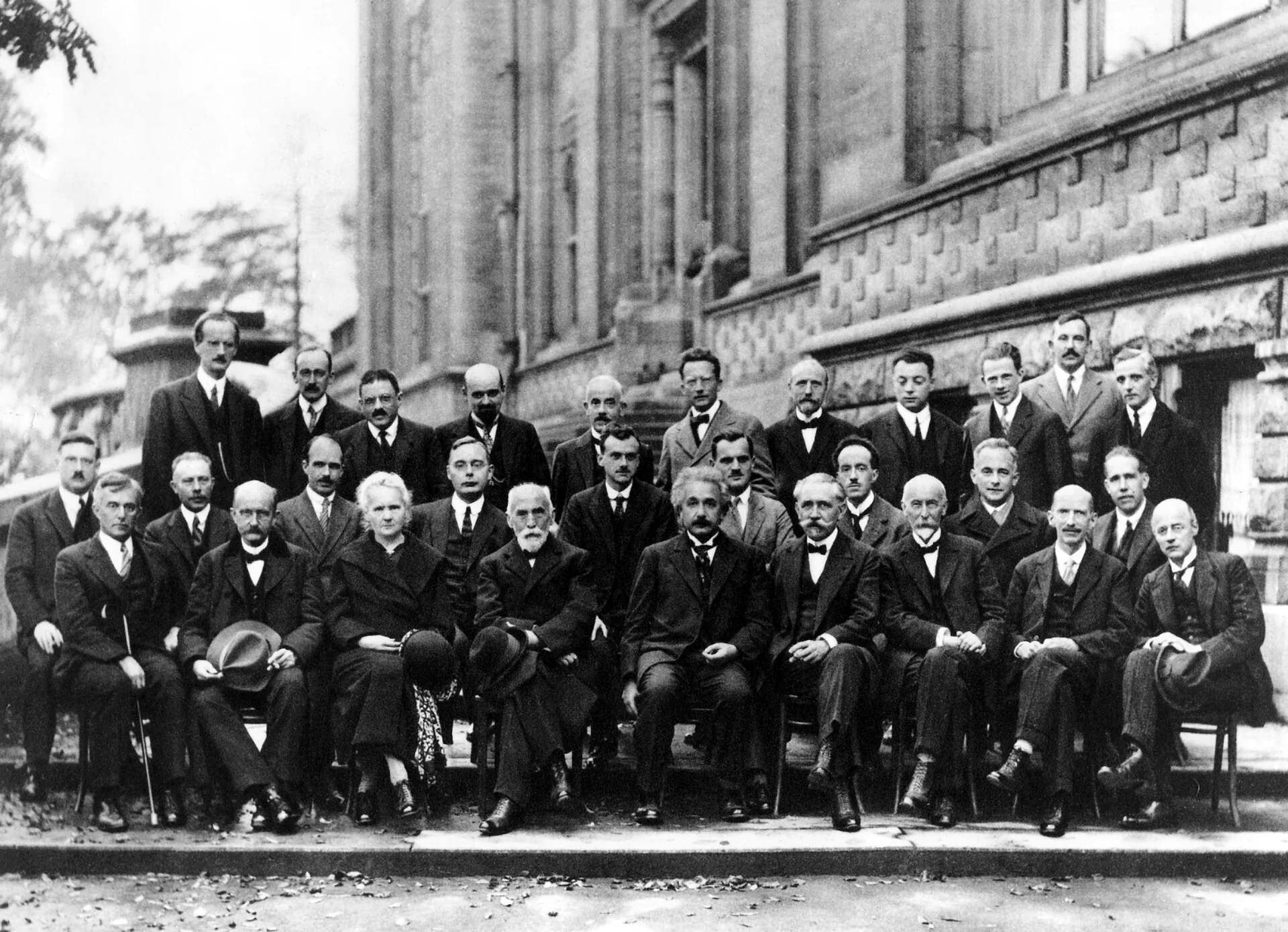
Quantum mechanics is certainly imposing. But an inner voice tells me that it is not yet the real thing.Albert Einsteinletter to Max Born, 4 December 1926, English translation