Behind the icon was a complicated, very human man — a passionate young lover, a difficult husband, a father who knew both pride and heartbreak, and a violinist who reached for Mozart when words failed. His private life was as turbulent as his physics was profound.
Mileva: the physicist he married
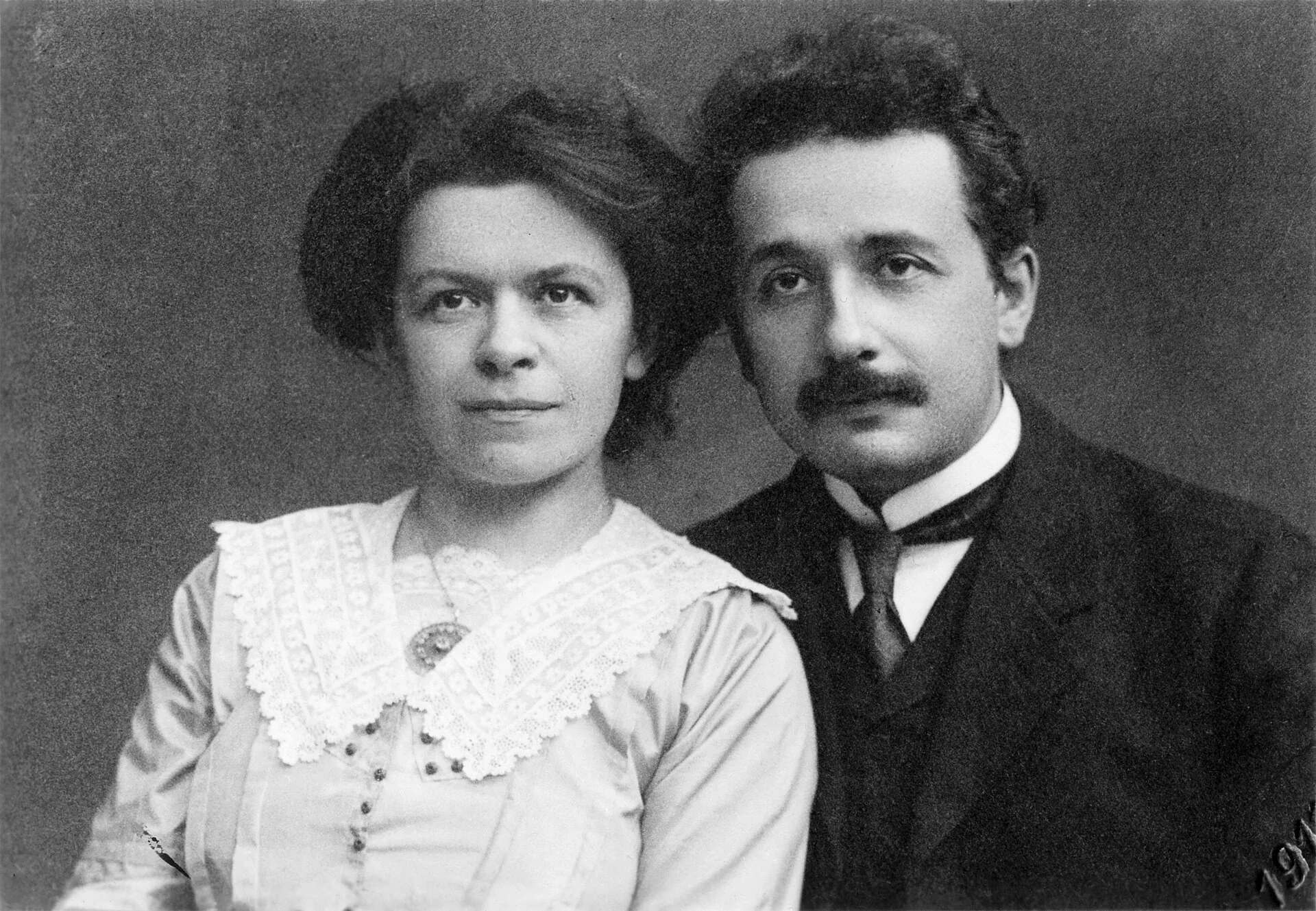
Albert and Mileva Marić. They met at the Zurich Polytechnic, where she was the only woman in their small class of physics and mathematics students.Image: Unknown author (ETH-Bibliothek Zürich). Public domain, via Wikimedia Commons (Source)
Mileva Marić was a brilliant Serbian woman, the only female student in Einstein's physics cohort at the Zurich Polytechnic. Their student love letters brim with physics and affection in equal measure. Before they married, Mileva bore a daughter, Lieserl, in 1902; the child's fate is unknown — she likely died of scarlet fever or was given up for adoption, and vanishes from the record.
They married in 1903 and had two sons: Hans Albert (1904), who became a respected professor of hydraulic engineering in California, and Eduard (1910), a gifted young man who developed schizophrenia and spent much of his life in care.
Open question Did Mileva help with his physics?
It is a genuine historical debate. Mileva was a trained physicist and his closest intellectual companion in the crucial years, and the couple discussed his ideas intensely. Some authors argue she contributed to the 1905 work; most historians find no firm evidence that she was a co-author of the discoveries, while recognising her as a sounding board and support. What is certain is that her own scientific career was sacrificed to marriage and motherhood — a common fate for talented women of her time.
As fame approached and the family moved to Berlin in 1914, the marriage collapsed. Einstein, increasingly distant, drew up a cold list of "conditions" for Mileva to remain in the household. She left, taking the boys back to Zurich. They separated in 1914 and divorced in 1919. The separation from his sons pained him; his relationship with Eduard, in particular, was a lasting sorrow.
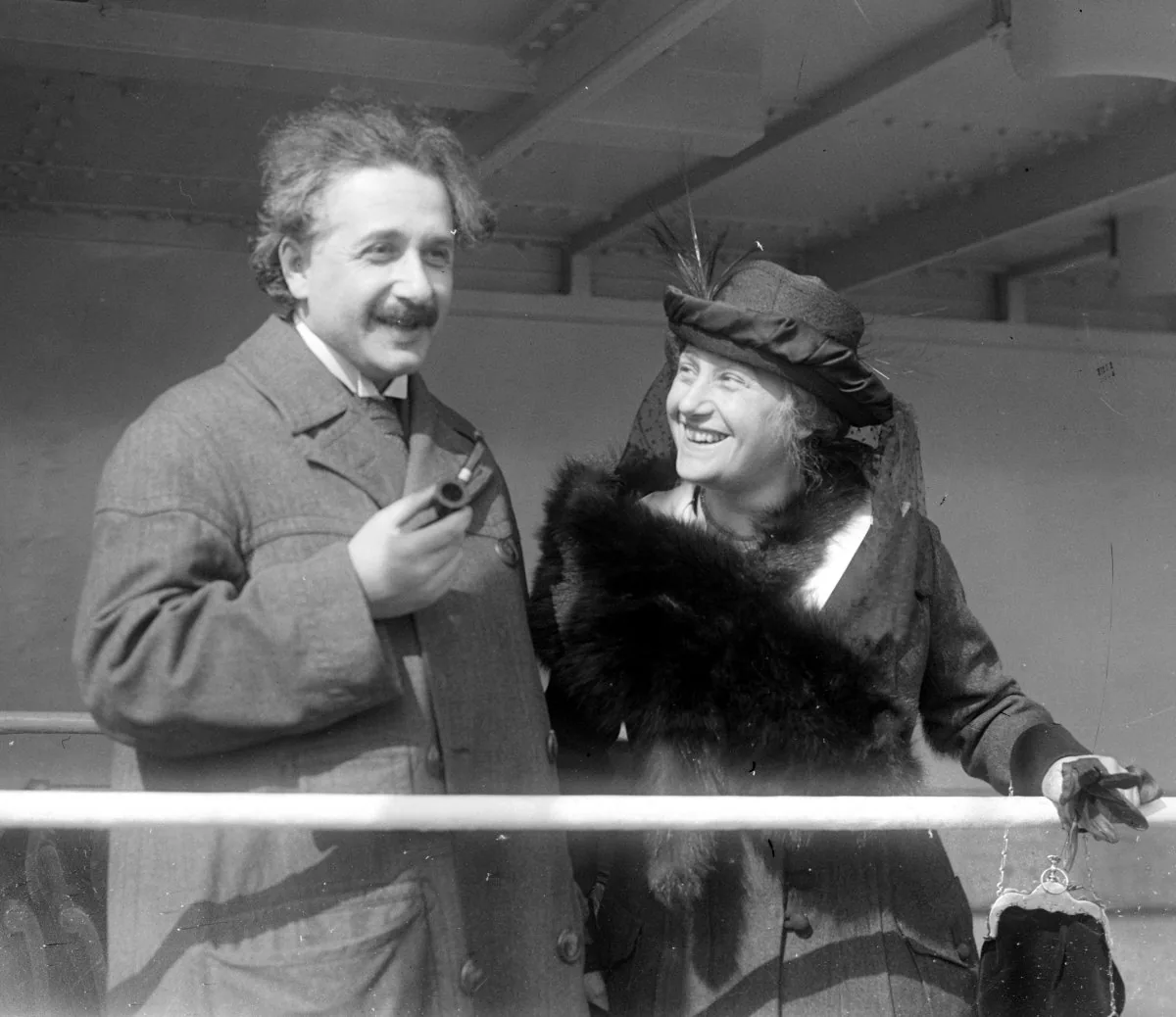
That same year, 1919, he married his cousin Elsa Löwenthal, who had nursed him through illness. Elsa managed his household and his fame with shrewd devotion, shielding the increasingly public Einstein from the world. He brought her two daughters, Ilse and Margot, into his life as stepdaughters.
Albert and Elsa Einstein. Elsa accompanied him into exile and managed his very public life until her death in 1936.Image: Underwood & Underwood, New York. Public domain, via Wikimedia Commons (Source)
Choose a person. The further out a name sits, the later Einstein got to know them.
At 76 (1955) Einstein knows 15 of the 15 people in this network. Of these, 7 have already died.
Family · since 1881 · died 1951
Maja Einstein
sister
His younger sister was born in Munich on 18 November 1881. He stayed deeply close to her all his life. Fleeing Mussolini’s racial laws, she left Italy in February 1939 to live with him in Princeton, where she died in 1951.
In 1896 she enrolled in mathematics and physics at the Zurich Polytechnic, the only woman in her year, attending the same lectures as Einstein. In 1902 their daughter Lieserl was born; what became of her is unknown. They married in 1903, separated in 1914 and divorced in 1919; under the divorce agreement she received the Nobel Prize money.
Open question: did she have a share in relativity?
In March 1901 Einstein wrote to her: “How happy and proud I will be when the two of us together will have brought our work on relative motion to a victorious conclusion!” For some, this points to joint work.
Decades later the physicist Abram Joffe recalled that the 1905 manuscripts had been signed “Einstein-Marity”. The originals are lost, and critics consider it unlikely that Joffe saw them before they were printed.
The Einstein editor John Stachel counts more than a dozen references to “my” work on the electrodynamics of moving bodies in the letters to her, against a single “our”, the passage of 1901 quoted above. No letters by Marić with scientific content survive. Many historians of science, Stachel among them, therefore see her as an important sounding board, not a co-author; others think a collaboration during their student years up to 1901 is possible. Neither side can be fully proven.
His careful lecture notes let Einstein catch up on the classes he had missed at the Polytechnic. Grossmann’s father helped him get his job at the patent office in Bern. In 1913 the two published the “Outline” (Entwurf), with Grossmann supplying the mathematics of curved spaces (Riemannian geometry), an important step towards general relativity.
The two met at a musical evening in Zurich in 1896. From 1904 Besso, on Einstein’s recommendation, also worked at the patent office; in the 1905 paper on special relativity he is the only person Einstein thanks. When Besso died in March 1955, Einstein wrote to his family:
“For us believing physicists the distinction between past, present and future only has the meaning of an illusion, though a persistent one.”
letter to Vero Besso and Bice Rusconi, 21 March 1955 (translated from German)
In 1902 the philosophy student answered Einstein’s newspaper advertisement for private lessons in Bern. The lessons turned into conversations, and with the mathematician Conrad Habicht they founded the “Olympia Academy”, a reading circle that usually met in Einstein’s flat. Solovine was a witness at his wedding in 1903 and later translated Einstein’s writings into French.
He was born in Bern on 14 May 1904 and became a hydraulic engineer; his 1936 doctoral thesis on how rivers carry sediment is regarded as a landmark. On his father’s advice he emigrated to the United States in 1938. From 1947 to 1971 he was a professor at the University of California, Berkeley.
Planck read Einstein’s 1905 paper on special relativity, was among the first to grasp its importance and made sure it was noticed. In early summer 1913 he travelled to Zurich with Walther Nernst to bring Einstein to Berlin. There they became friends and often played music together, even though Planck long rejected Einstein’s light quanta.
He was born in Zurich on 28 July 1910, was musical and began studying medicine to become a psychiatrist. In January 1933 he was diagnosed with schizophrenia; in all he spent almost 14 years at the Burghölzli clinic in Zurich. After his father emigrated they never saw each other again; their letters grew rarer but never stopped.
Both took part in the first Solvay Conference in Brussels in 1911, she as the only woman. When French newspapers attacked her soon afterwards, Einstein stood by her together with other scientists. In 1913 they went on a summer excursion to the Engadine together; later both sat on the League of Nations’ Committee on Intellectual Cooperation.
They met in Prague in 1912 and remained close friends. At Ehrenfest’s invitation Einstein became a special professor in Leiden in 1920 and stayed at his house on his yearly visits. In 1925 Ehrenfest invited Einstein and Niels Bohr to Leiden together, hoping to ease their dispute over quantum theory. He suffered from severe depression and died in 1933.
As children the two played together on family visits in Munich. In April 1912 they began a relationship while Einstein was still married to Mileva; they married on 2 June 1919. Elsa went into exile with him and died in Princeton on 20 December 1936.
They met when Bohr visited Berlin in 1920. At the Solvay Conferences of 1927 and 1930 they argued with thought experiments about whether quantum mechanics is complete; the “Bohr–Einstein debates” became famous. Of Bohr’s model of the atom Einstein wrote:
“This is the highest form of musicality in the sphere of thought.”
Autobiographical Notes, 1949 (in P. A. Schilpp, Albert Einstein: Philosopher-Scientist; translated from German)
As a young Hungarian in Berlin he attended Einstein’s lectures; Einstein praised his 1922 doctoral thesis. From 1926 to 1930 they worked together on a refrigerator with no moving parts. In August 1939 Szilárd persuaded him to sign the letter to President Roosevelt warning of a German atomic bomb.
She was Einstein’s secretary from 1928; after Elsa died in 1936 she also ran the household in Princeton. In his will Einstein named her, together with Otto Nathan, as trustee of his written legacy. Both helped lay the groundwork for the edition of his collected papers.
The logician met Einstein in 1933 on his first trip to the United States; from 1940 both lived in Princeton. They became known for their long walks together to and from the Institute; what they talked about remained a mystery to their colleagues. In 1947 Einstein went with him as a witness to his citizenship examination.
Counted by calendar year (year = 1879 + age). For Maja it is her birth, for Planck the year he read Einstein’s paper, for Elsa the start of their relationship.
The man, off the page
Music
Einstein played the violin from childhood and adored Mozart. "If I were not a physicist," he said, "I would probably be a musician." Music was how he thought when equations stalled.
Sailing
He loved sailing — though he never learned to swim, and more than once had to be rescued after mishaps on the water. He sailed for the daydreaming, not the speed.
Indifference to appearances
He famously avoided socks and rarely cut his wild hair. It was not eccentricity for show, but a deep impatience with convention.
Contradictions
Warm and witty in public, he could be remote in private. He had several affairs during his second marriage. By his own account, his passion for social justice sat oddly beside a pronounced lack of need for close contact with other people.
I am a horse for single harness, not cut out for tandem or team work. I have never belonged wholeheartedly to country or state, to my circle of friends, or even to my own family.Albert Einstein"What I Believe", 1930
Sources:
Wikipedia: Albert Einstein; Einstein, What I Believe (Forum and Century, 1930; German: Wie ich die Welt sehe, in Mein Weltbild, 1934).