Chapter 02 · 1900–1905
1905 — The Miracle Year
No university would hire him. So Einstein examined patents by day and rebuilt physics by night. In the space of seven months in 1905 — his annus mirabilis — he published four papers, any one of which could have made a career. Together they remade our picture of reality.
The lean years that came first
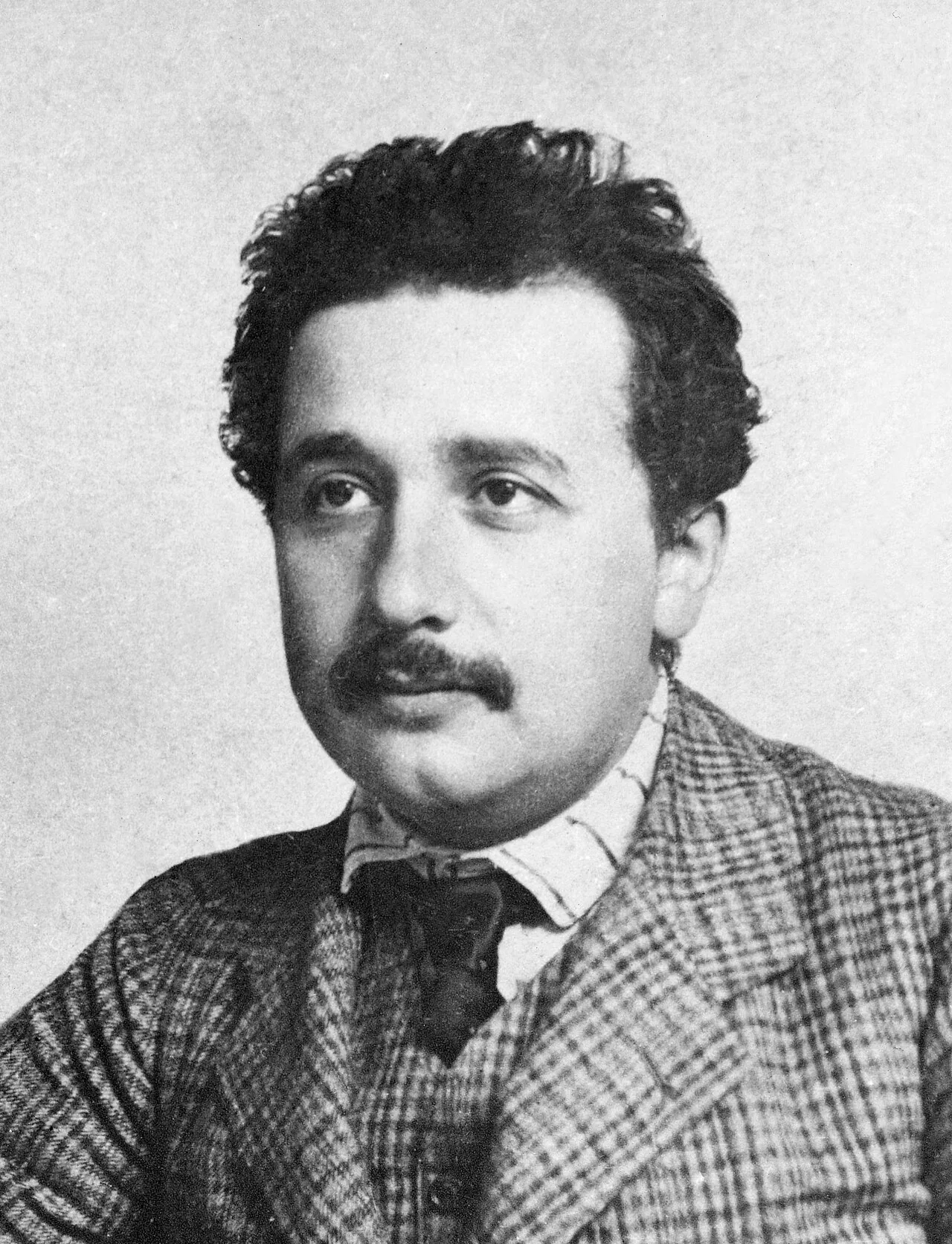
Graduating in 1900 did not open doors. Einstein's professors found him impudent, and for two years he scraped by on tutoring and temporary teaching. In 1902, his classmate Marcel Grossmann's father recommended him for a post at the Swiss Federal Patent Office in Bern, where he became a "technical expert, third class," assessing inventions — many of them electromechanical.
It suited him perfectly. The work was interesting but undemanding, leaving hours for thinking. In 1903 he married Mileva Marić; their son Hans Albert was born in 1904. With friends he formed the half-joking "Olympia Academy", reading Poincaré, Hume and Mach late into the night.
- Wikipedia: Annus Mirabilis papers.
- Wikipedia: Albert Einstein — "Patent office".
Four papers, one year
The 1905 papers
All four appeared in the Annalen der Physik. Here they are in the order he wrote them.
March — Light quanta & the photoelectric effect
Light, Einstein proposed, comes in discrete packets of energy (later called photons), each carrying energy E = hf. This "very revolutionary" idea explained the photoelectric effect — and, sixteen years later, won him the Nobel Prize. It also helped launch quantum theory.
May — Brownian motion
By explaining the jittering of tiny particles suspended in water as the result of collisions with invisible molecules, Einstein gave direct evidence that atoms and molecules are real — still doubted by some scientists in 1905. Jean Perrin's experiments soon confirmed it.
June — Special relativity
"On the Electrodynamics of Moving Bodies" demolished the idea of absolute time and space. From two simple postulates, Einstein derived that moving clocks run slow and moving objects contract. We give it a whole chapter.
September — Mass–energy equivalence
A three-page afterthought to the relativity paper asked whether a body's mass depends on its energy. The answer became the most famous equation on Earth: E = mc². Explore it here.
Each of the four articles carries its date of receipt in the Annalen der Physik itself. The calendar lays them out across 1905 together with the dissertation — and shows how old Einstein was on each of those days.
- en.wikipedia: Annus mirabilis papers · de.wikipedia: Annus mirabilis · de.wikipedia: Albert Einstein · de.wikipedia: Geschichte der speziellen Relativitätstheorie
- Annalen der Physik 17 (1905), S. 132–148 (Faksimile) · Annalen der Physik 17 (1905), S. 549–560 (Faksimile) · Annalen der Physik 17 (1905), S. 891–921 (Faksimile) · Annalen der Physik 18 (1905), S. 639–641 (Faksimile) · Annalen der Physik 19 (1906), S. 289–306 (Faksimile)
Then suddenly I understood where the key to this problem lay.Albert Einsteinlecture in Kyoto, 14 December 1922 (notes by J. Ishiwara, translated by Y. A. Ono), on the breakthrough of May 1905
Recognition came slowly. Among the first to take real notice, and the first to build on his theory, was Max Planck, the founder of quantum theory, whose interest helped Einstein's relativity gain traction. Within four years the patent clerk had his first professorship, in Zurich. The academic outsider of 1905 would, within fifteen years, be the most famous scientist alive.
- Wikipedia: Annus Mirabilis papers.
- John Stachel (ed.), Einstein's Miraculous Year (1998).
- Einstein, Kyoto lecture of 14 Dec. 1922, in Y. A. Ono, Einstein's speech at Kyoto, Physics Today 35 (8), 1982.