Chapter 01 · 1879–1900
Early Life & Education
A quiet boy from a family of electrical engineers, a magnetic compass that felt like magic, and a rebellious teenager who walked out of school — long before the world's most famous scientist, there was a curious child in southern Germany.
Born in Ulm, 1879
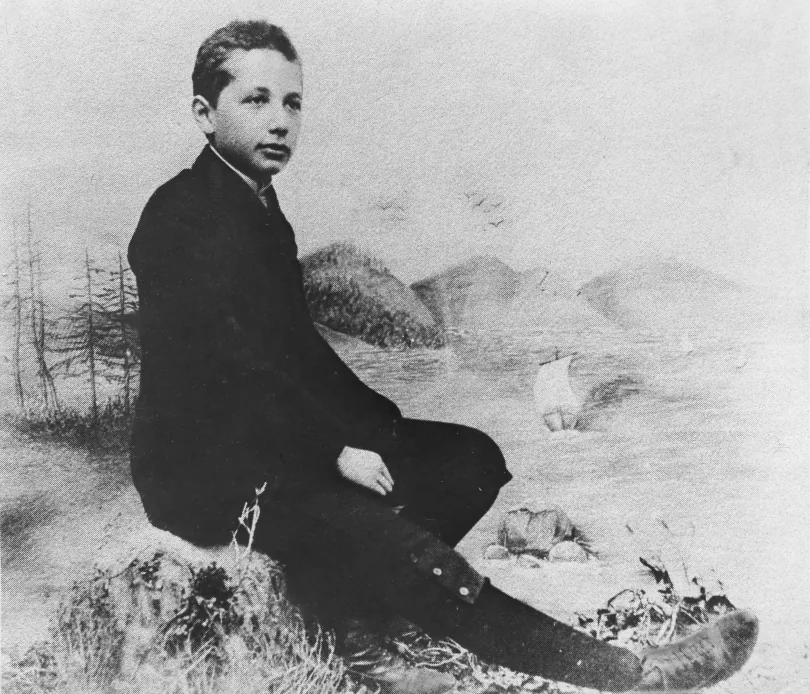
Albert Einstein was born on 14 March 1879 in Ulm, in the Kingdom of Württemberg in the German Empire, to Hermann Einstein, a salesman and engineer, and Pauline Einstein (née Koch). The family was Jewish but largely non-observant.
A year later, in 1880, the family moved to Munich, where Hermann and his brother Jakob founded an electrical-engineering company that manufactured direct-current equipment. Albert's sister, Maja, was born in 1881; the two would remain close for their entire lives.
As a young child Albert was slow to speak, and the family maid reportedly nicknamed him for his hesitant manner. But he was watchful and stubbornly independent — traits that would define both the scientist and the man.
- Wikipedia: Albert Einstein — section "Early life and education".
- Walter Isaacson, Einstein: His Life and Universe (2007), ch. 1.
At twelve he was given a small book on Euclidean geometry, which he called his "holy little geometry book." Its clear, certain proofs thrilled him. With help from Max Talmud (later Talmey), a young medical student who dined weekly with the family, Albert raced through mathematics and popular science, teaching himself calculus while still a boy.
At the age of twelve I experienced a second wonder of a totally different nature: in a little book dealing with Euclidean plane geometry, which came into my hands at the beginning of a school year.Albert EinsteinAutobiographical Notes, 1949
- Wikipedia: Albert Einstein — "Early life".
- Albert Einstein, Autobiographical Notes (1949).
A schoolboy who would not be drilled
Einstein attended a Catholic elementary school and then the Luitpold Gymnasium in Munich. He did well academically — especially in mathematics and physics — but he chafed against the school's rigid, rote-learning discipline, which he later compared to military drill. He valued understanding over obedience, and it showed.
In 1894 the family's electrical business lost a key contract and the Einsteins moved to Italy, first to Milan and soon to Pavia, in search of better prospects. Fifteen-year-old Albert was left behind in Munich to finish school. Within months he had had enough: he obtained a doctor's note, left the Gymnasium without a diploma, and crossed the Alps to rejoin his family.
Myth-busting Did Einstein really fail mathematics?
No. This is one of the most persistent myths about him. Einstein was an excellent mathematics and physics student from a young age; he had mastered advanced material as a teenager. The confusion may stem from a 1935 newspaper item, which Einstein himself laughed off: "I never failed in mathematics. Before I was fifteen I had mastered differential and integral calculus."
What he did struggle with was the broad entrance examination of the Zurich Polytechnic in 1895 — he was two years younger than the usual candidates and fell short in non-science subjects such as French — not mathematics.
- Wikipedia: Albert Einstein.
- Multiple biographies and fact-checks on the "Einstein failed math" legend.
Stateless, then Swiss
To avoid compulsory German military service, Einstein renounced his German (Württemberg) citizenship in 1896, with his father's consent. For the next five years he was officially stateless. He would not hold citizenship again until he became a Swiss citizen in 1901 — a nationality he kept, with pride, for the rest of his life.
In 1895, aged sixteen, he sat the entrance exam for the Swiss Federal Polytechnic in Zurich (the ETH). He scored brilliantly in mathematics and physics but missed the mark overall, so on the advice of the school he spent a year at the cantonal school in Aarau to complete his secondary education. He thrived in its liberal, Pestalozzi-inspired atmosphere — and it was here, he later said, that he first imagined chasing a beam of light, the thought experiment that would haunt him for a decade.
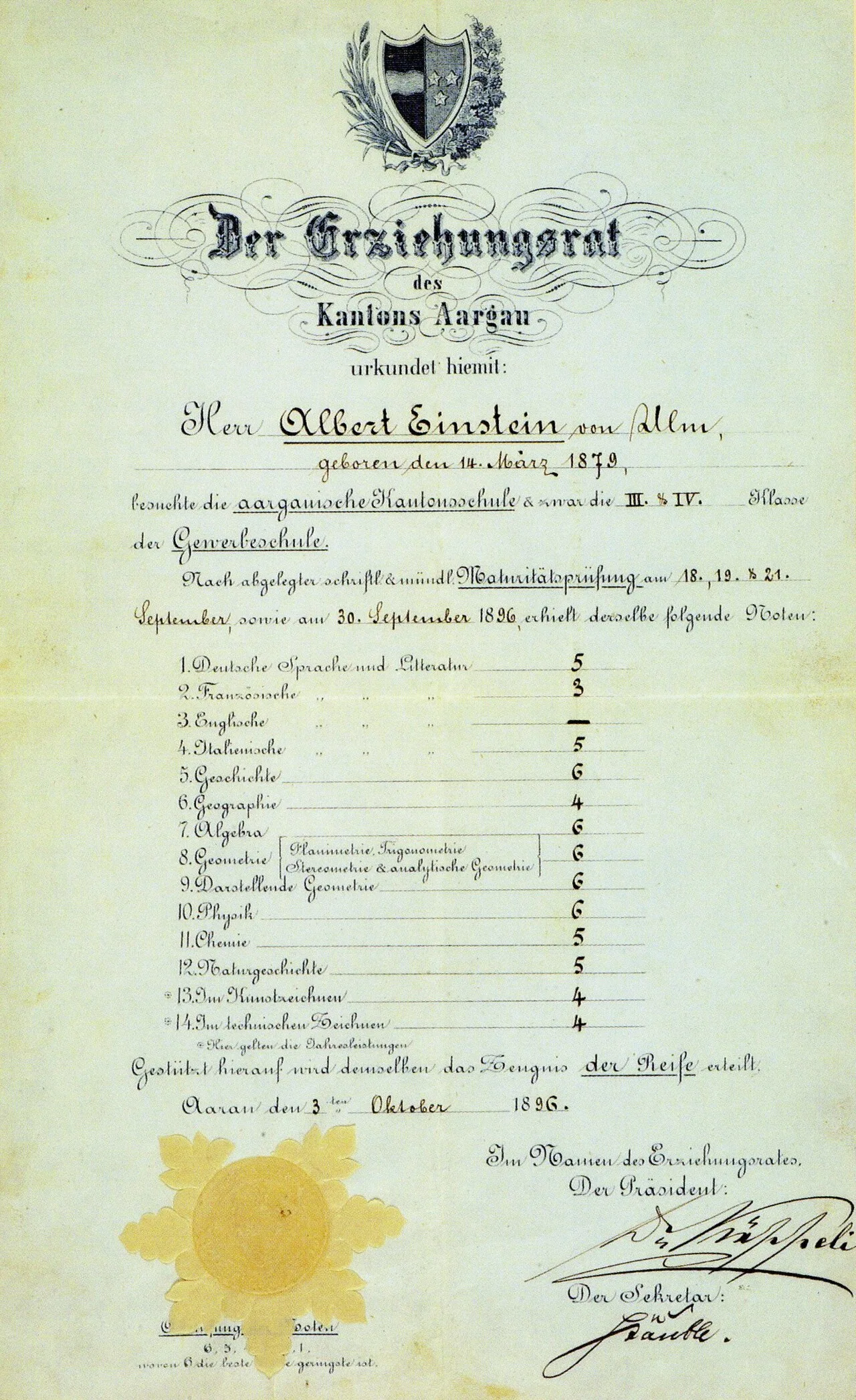
He passed the Swiss Matura in 1896 with outstanding grades in the sciences. That autumn, aged seventeen, he enrolled at the Zurich Polytechnic in the four-year programme that trained mathematics and physics teachers.
Among his classmates were his lifelong friend Marcel Grossmann — a gifted mathematician who would later hand Einstein the geometric tools for general relativity — and Mileva Marić, the only woman in the class and the woman he would marry. He graduated in 1900.
- Wikipedia: Albert Einstein — "Early life and education".
- Wikipedia: ETH Zurich.
- Image: Canton of Aargau, public domain, via Wikimedia Commons.