Reference
Glossary
Key terms from Einstein's life and science, explained in plain language. Anywhere on the site, hover or tap a highlighted word for a quick definition and a link here.
20 terms
Glossary — 20 terms
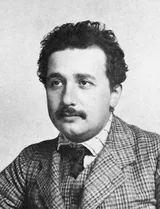
Annus mirabilis (1905)
Einstein's “miracle year” 1905, when he published four physics-changing papers.
Detail Image: Lucien Chavan. Public domain, via Wikimedia Commons (Source)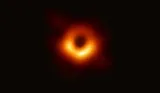
Black hole
A region where gravity is so strong that not even light can escape.
Detail Image: Event Horizon Telescope Collaboration. CC BY 4.0, via Wikimedia Commons (Source)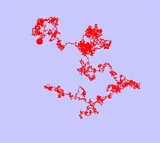
Brownian motion
The random jitter of tiny particles in a fluid — explained by Einstein in 1905, key evidence that atoms are real.
Detail Image: Roque345 (Wikipedia). CC BY 3.0, via Wikimedia Commons (Source)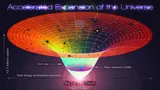
Cosmological constant
A term Einstein added to his equations to keep the universe static — later reportedly his “biggest blunder.”
Detail Image: Coldcreation (Wikipedia). CC BY-SA 3.0, via Wikimedia Commons (Source)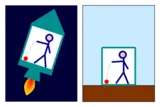
Equivalence principle
Gravity and acceleration are locally indistinguishable — Einstein's key to general relativity.
Detail Image: Markus Pössel / Pbroks13 (Wikimedia Commons). CC BY-SA 3.0, via Wikimedia Commons (Source)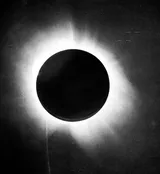
General relativity
Einstein's 1915 theory of gravity as the curvature of spacetime by mass and energy.
Detail Image: F. W. Dyson, A. S. Eddington & C. Davidson. Public domain, via Wikimedia Commons (Source)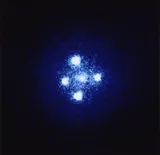
Gravitational lensing
Massive objects bend passing light, acting like a cosmic lens that distorts distant images.
Detail Image: NASA, ESA & STScI. Public domain, via Wikimedia Commons (Source)
Gravitational waves
Ripples in spacetime from violent cosmic events — predicted 1916, first measured 2015.
Detail Image: MOBle (Wikipedia). Public domain, via Wikimedia Commons (Source)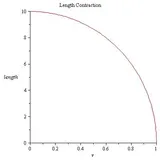
Length contraction
A moving object is measured as shorter along its direction of motion.
Detail Image: JRobbins59 (Wikipedia). Public domain, via Wikimedia Commons (Source)
Mass–energy equivalence
E = mc²: mass is a form of energy; a little mass corresponds to an enormous amount of energy.
Detail Image: Lucien Chavan. Public domain, via Wikimedia Commons (Source)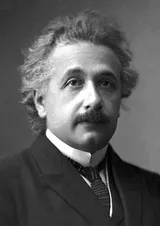
Nobel Prize in Physics
The premier prize in physics; Einstein won the 1921 award for the photoelectric effect.
Detail Image: Nobel Foundation (photo possibly Herman Mishkin). Public domain, via Wikimedia Commons (Source)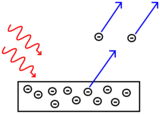
Photoelectric effect
Light knocking electrons out of a metal — explained by Einstein with light quanta (1905).
Detail Image: Wolfmankurd (Wikipedia). CC BY-SA 3.0, via Wikimedia Commons (Source)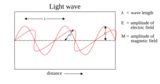
Photon
A single quantum (particle) of light, carrying energy proportional to its frequency.
Detail Image: Gpvos (Wikipedia). CC BY-SA 3.0, via Wikimedia Commons (Source)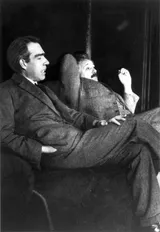
Quantum entanglement
Linked particles whose measurements stay correlated however far apart — Einstein's “spooky action.”
Detail Image: Paul Ehrenfest. Public domain, via Wikimedia Commons (Source)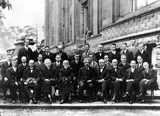
Quantum mechanics
The physics of the very small, where energy is quantised and outcomes are probabilities.
Detail Image: Benjamin Couprie, Institut International de Physique Solvay. Public domain, via Wikimedia Commons (Source)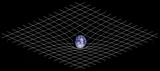
Spacetime
The four-dimensional fabric that fuses the three dimensions of space with time.
Detail Image: Johnstone (Wikipedia). CC BY-SA 3.0, via Wikimedia Commons (Source)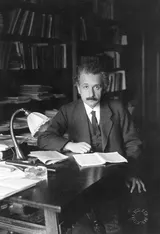
Special relativity
Einstein's 1905 theory: the speed of light is the same for everyone, so space and time are relative.
Detail Image: Unknown photographer (ETH-Bibliothek Zürich). Public domain, via Wikimedia Commons (Source)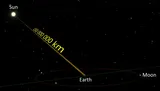
Speed of light
c ≈ 299,792 km/s — the same for every observer and the universe's ultimate speed limit.
Detail Image: LucasVB. Public domain, via Wikimedia Commons (Source)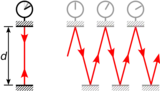
Time dilation
Moving (or gravitationally lower) clocks tick more slowly than stationary ones.
Detail Image: Michael Schmid / DB (Wikimedia Commons). CC BY-SA 3.0, via Wikimedia Commons (Source)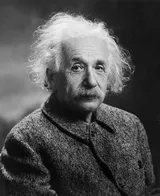
Unified field theory
A single framework uniting all forces of nature — Einstein's unfinished final quest.
Detail Image: Orren Jack Turner. Public domain, via Wikimedia Commons (Source)The concept map
How the terms hang together: a line joins two terms when the explanation of one names the other. The larger the dot, the more connections. Point at a term (or tap it once) to highlight its neighbours; a click or a second tap opens its explanation.