Chapter 03 · The Science
Special Relativity
Imagine chasing a beam of light. Einstein had that daydream at sixteen, and spent ten years chasing its consequences. The answer, published in 1905, was that space and time are not the fixed stage we assume — they stretch and squeeze so that one thing stays absolute: the speed of light.
Two simple ideas
Special relativity rests on just two postulates. They sound innocent. They are not.
1 · The principle of relativity
The laws of physics are the same for everyone moving at a constant velocity. There is no experiment you can do inside a smoothly moving train to tell whether you are moving or standing still.
2 · The constancy of light
The speed of light in a vacuum, c ≈ 299,792 km/s, is the same for every observer — no matter how fast they or the light source are moving. Chase a light beam at 99% of c, and it still races away from you at the full c.
- Wikipedia: Special relativity.
- A. Einstein, "Zur Elektrodynamik bewegter Körper", Annalen der Physik 17 (1905).
Thought experiment · Aarau, 1895/96
Chasing a beam of light
At sixteen, as a pupil at the cantonal school in Aarau, Einstein puzzled over a question: what if you could chase a beam of light at the speed of light itself? Looking back half a century later, he wrote:
…a paradox upon which I had already hit at the age of sixteen: If I pursue a beam of light with the velocity c (velocity of light in a vacuum), I should observe such a beam of light as an electromagnetic field at rest though spatially oscillating. There seems to be no such thing, however, neither on the basis of experience nor according to Maxwell's equations.Albert EinsteinAutobiographical Notes, in P. A. Schilpp (ed.), Albert Einstein: Philosopher-Scientist (1949; 2nd ed. 1951, pp. 52–53); translated from the German by P. A. Schilpp
Try it yourself. At the top a ball flies at 100 km/h, below it a beam of light. The slider sets how fast you run after them – as a share of the ball’s speed and of light’s.
For the ball, everyday arithmetic works: you simply subtract your speed. For light it does not. However fast you go, you always measure the same 299,792 km/s. That is exactly the principle Einstein put at the start in 1905: the speed of light in a vacuum is the same for everyone moving uniformly. For that to hold for everyone at once, time and length have to give way – which is what the rest of this chapter is about.
For the curious: the maths
Newton simply subtracts: relative speed = u − v. According to Einstein, for a speed u (measured from the ground) and your speed v in the same direction:
u′ = (u − v) / (1 − u·v/c²)
For light u = c, so u′ = (c − v) / (1 − v/c) = c – for every v below c. For the ball (u = 100 km/h, v = 90 km/h), u·v/c² ≈ 7.7 × 10⁻¹⁵: the result differs from 10 km/h by less than a trillionth of a km/h. That is why the ball flies at an everyday speed – there, Newton is accurate enough.
The posts along the light lane crowd together at high speed: in your frame their spacing is shortened by the factor γ = 1/√(1 − v²/c²), about 22 times at 99.9 % (length contraction). The drawing shows what you measure, not what your eye would see.
- Wikipedia: Einstein’s thought experiments, section “Pursuing a beam of light” – Einstein’s recollection in the Autobiographical Notes and John D. Norton’s objections
- John D. Norton: Chasing the Light – Einstein’s Most Famous Thought Experiment (PDF)
- Wikipedia: Speed of light
- Wikipedia: Michelson–Morley experiment
- Wikipedia: Emission theory, section “Terrestrial sources” (Alväger et al. 1964)
- Wikipedia: Velocity-addition formula
What follows: time stretches
From those two postulates, Einstein derived effects that have since been confirmed countless times — by particle accelerators, atomic clocks flown around the world, and the GPS in your phone.
Time dilation
A moving clock ticks slower than a stationary one. Travel fast enough and you would age more slowly than the people you left behind.
Length contraction
A moving object is measured as shorter along its direction of motion. At near-light speed, a spaceship would appear squashed.
Relativity of simultaneity
Two events that look simultaneous to you may happen at different times for someone moving relative to you. "Now" is not universal.
The cosmic speed limit
Nothing with mass can reach c. As you approach it, the energy needed grows without limit — which is exactly what E = mc² describes.
Thought experiment · Einstein 1917
Train and lightning: what does “simultaneous” mean?
For his popular book Relativity: The Special and the General Theory (German original with a preface dated December 1916, published in 1917 by Vieweg in Braunschweig) Einstein came up with a picture that still appears in almost every textbook. A very long train runs at constant speed along an embankment. Lightning strikes at two places, A and B. Exactly halfway between A and B, an observer M stands on the embankment; in the middle of the train sits an observer M′, who is passing her at the very moment of the strikes.
The light from both flashes reaches M at the same moment – for the embankment, the strikes are simultaneous. But M′ is rushing towards the light from B and away from the light from A. He sees B first. Because the speed of light is the same in both directions inside the train too, and both strike points on the train are equally far from him, he has to conclude that B struck earlier than A. This is not an illusion caused by the light's travel time; it is what remains after that travel time has been subtracted.
Switch the calculator to “View from the train”: now the train is at rest, the embankment slides past, and the flashes really do strike one after the other. Both pictures describe the same events, and they agree on who sees what, and in which order. The train looks longer in its own frame, because its rest length is γ times the length measured from the embankment.
The calculator uses the Lorentz transformation t′ = γ·(t − v·x/c²). Two events that happen simultaneously a distance L apart in the embankment frame are separated by γ·v·L/c² in the train frame – at half the speed of light and 300 m, about 578 nanoseconds. At 100 km/h it would be only about 0.09 picoseconds, less than a tenth of a trillionth of a second, which is why nobody notices in everyday life. Incidentally, the train does not appear in the 1905 paper: there Einstein derived the relativity of simultaneity from the question of how distant clocks are synchronised.
Events which are simultaneous with reference to the embankment are not simultaneous with respect to the train, and vice versa (relativity of simultaneity).Albert EinsteinRelativity: The Special and the General Theory, ch. IX (tr. R. W. Lawson, 1920)
- A. Einstein, Relativity: The Special and the General Theory, authorised translation by R. W. Lawson (1920), ch. IX “The Relativity of Simultaneity” (Project Gutenberg); German original: Über die spezielle und die allgemeine Relativitätstheorie, Braunschweig: Vieweg 1917, § 9.
- Wikipedia: Relativity of simultaneity – the train is not in the 1905 paper; Lorentz transformation.
Try it yourself
The time-dilation machine
How much does time really slow down? Drag the slider to set your speed as a fraction of the speed of light, and watch what happens to one year of travel.
- Wikipedia: Time dilation — experimental confirmations.
- Wikipedia: GPS — relativistic corrections.
Try it with your own age
The twin paradox
Time dilation has a famous consequence. As early as 1905 Einstein concluded that if one of two synchronised clocks is moved from A to B, it will afterwards lag behind the clock that waited at B. In 1911 the French physicist Paul Langevin turned this into the story of a space traveller who ages two years while 200 years pass on Earth. Today it is told with twins: one stays on Earth, the other flies to a star at close to the speed of light and back – and returns younger than his sister.
The calculator deliberately simplifies: the ship flies out and back at a constant speed and turns round instantly; speeding up, turning and braking are left out, and the Earth is treated as being at rest. The time that passes on Earth is then 2 × distance ÷ speed; on board, only a γ-th of that. Distances are taken from the English Wikipedia; for Betelgeuse the distance is uncertain (roughly 400 to 600 light-years).
- Wikipedia: Twin paradox – Einstein 1905, Langevin 1911, two inertial frames, turnaround without acceleration.
- Distances (English Wikipedia): Alpha Centauri (Proxima 4.2465 ly, α Cen AB 4.344 ly); Sirius (8.6 ly); Betelgeuse (548 ly; estimates 400–600 ly); Galactic Center (about 26,000 ly); Andromeda Galaxy (about 2.5 million ly).
Spacetime: Minkowski's gift
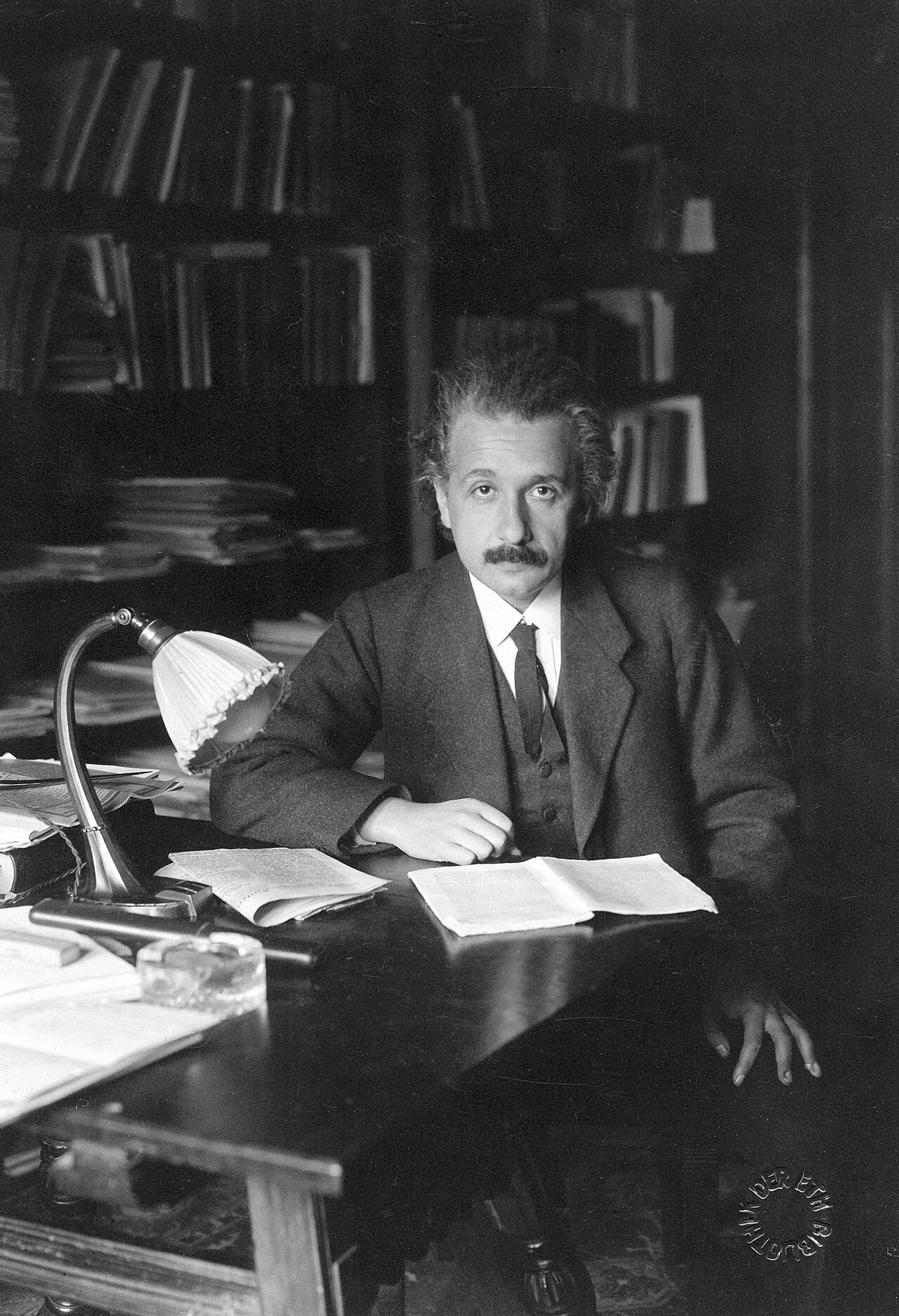
In 1908 the mathematician Hermann Minkowski — once Einstein's teacher at the ETH in Zurich — showed that special relativity is most naturally described by fusing space and time into a single four-dimensional fabric: spacetime. Events have not just a place but a place and a moment, woven together.
Einstein at first dismissed the idea as mathematical decoration. He soon changed his mind. Spacetime became the stage on which he would build his masterpiece — general relativity, in which that fabric itself bends.
People like us, who believe in physics, know that the distinction between past, present and future is only a stubbornly persistent illusion.Albert Einsteinletter to the family of Michele Besso, 21 March 1955 (German original; English after F. Dyson)