Proving ground · Quantum

The great debate

For years, two of the greatest physicists of the 20th century argued about what quantum mechanics really says about the world. Einstein devised thought experiments to catch the theory out; Niels Bohr looked for the flaw in each one. Follow the arguments yourself – and predict who has the better answer.

Two friends, one disagreement

Einstein had helped to found quantum physics himself: in 1905 he explained light as made of quanta, and it was chiefly for this work on the photoelectric effect that he received the Nobel Prize. But when Werner Heisenberg, Max Born, Erwin Schrödinger, Niels Bohr and others built a complete quantum mechanics from 1925 onwards, Einstein was unhappy. He did not doubt that the theory calculated correctly. He doubted that it described the whole of reality – that chance should be built into the laws of nature themselves.

Bohr, the Danish founder of the Copenhagen institute, defended the new theory. The two respected each other greatly. Their arguments – at the Solvay conferences in Brussels in 1927 and 1930, and in print in 1935 – are among the most famous discussions in the history of physics.

Quantum mechanics is certainly imposing. But an inner voice tells me that it is not yet the real thing. The theory says a lot, but does not really bring us any closer to the secret of the ‘old one.’ I, at any rate, am convinced that He does not throw dice.Albert Einsteinletter to Max Born, 4 December 1926 (English translation; German original in Einstein/Born, Briefwechsel 1916–1955, Munich 1969, p. 129 f.)

This became the catchphrase “God does not play dice”; the letter does not put it that briefly.
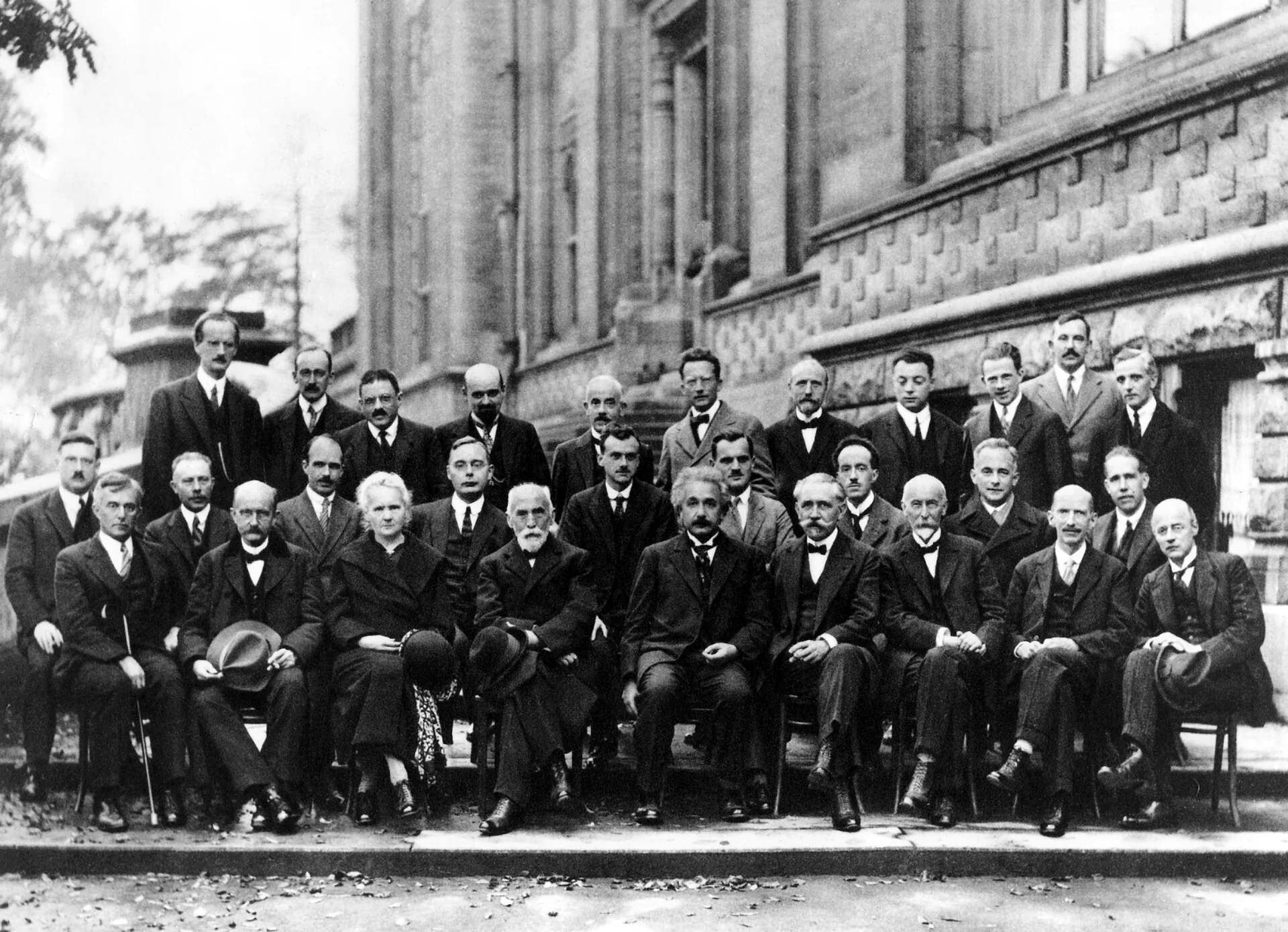
Group photograph of the fifth Solvay Conference in 1927, with physicists in three rows
The fifth Solvay Conference, Brussels, October 1927. Einstein sits in the middle of the front row, Bohr at the right end of the middle row.Image: Benjamin Couprie, Institut International de Physique Solvay. Public domain, via Wikimedia Commons (Source)

Follow the debate

Each round has three steps: follow Einstein's line of thought, predict Bohr's answer, then read the documented resolution.

Interactive · dialogue puzzle

Einstein and Bohr: three rounds

Round 1 · Brussels, October 1927

The slit that recoils

  1. Electrons fly one at a time through two slits. After many electrons, a pattern of stripes builds up on the screen behind – as if each electron passed through both slits like a wave.
  2. Einstein, as Bohr later told it, suggested hanging a first screen with a single slit on springs so that it can move. If an electron then heads for the upper slit, it is deflected upwards and gives the screen a tiny kick downwards – and vice versa. The recoil would reveal which slit the electron took.
  3. Then you would have both: the path of every electron and the stripe pattern. Quantum mechanics and Heisenberg's uncertainty principle (1927) say that is impossible. Einstein's question: is the theory simply too cautious here?

Your prediction

What does Bohr reply?

Bohr's answer and the resolution

Bohr answered that the first screen is also an object to which the uncertainty principle applies. To read the path from its recoil, you have to know its momentum very precisely. Then its position is uncertain – by just about the spacing between two stripes. The bright and dark stripes of many electrons then fall on top of each other, and the pattern becomes evenly grey. Path or stripes: you cannot have both at once.

A historical footnote: we know this exchange mainly from Bohr's account of 1949, which he wrote from memory. In the printed proceedings of the 1927 conference, Einstein's objection takes a different form – a single slit and a hemispherical screen. There he asked how it is that the particle arrives at only one point when its wave spreads over the whole screen, an early form of his worry about action at a distance.

Round 2 · Brussels, 1930

The box of light

  1. A box full of light hangs from a spring balance. In one wall there is a hole with a shutter, opened by a clock inside the box for a precisely known, short moment. One photon escapes.
  2. The box is weighed before and after. According to E = mc², the difference in weight gives the photon's energy – as precisely as you like, if you weigh precisely.
  3. Then the moment (from the clock) and the energy (from the balance) would both be known sharply. Quantum mechanics says: the more precisely the moment is fixed, the more uncertain the energy (energy–time uncertainty). Einstein's aim: to get round this limit.

Your prediction

What does Bohr reply?

Bohr's answer and the resolution

Léon Rosenfeld, who was there, later reported that the objection came as a real shock to Bohr, who was very agitated that evening and only found the answer the next morning. It lies in the balance. To read the weight precisely, you have to know the position of the box on a scale precisely. The more precisely you know the position, the more uncertain its momentum – and with it how precisely the weight can be determined in the time available. And because the box hangs in the Earth's gravitational field, a discovery Einstein himself had derived from his equivalence principle (1907/1911) applies: clocks at different heights run at different rates. An uncertainty in the height of the box therefore becomes an uncertainty in the reading of its clock. Put the two together and you get exactly the energy–time uncertainty.

After 1930 Einstein no longer attacked the internal consistency of quantum mechanics. His new question was: is it complete?

Round 3 · Princeton, 1935

Two particles, far apart

  1. Einstein, Boris Podolsky and Nathan Rosen consider two particles that once interacted and then fly far apart. Their properties are linked so that a measurement on one particle lets you predict with certainty what the matching measurement on the other will give.
  2. Their criterion: if you can predict a value without in any way disturbing a particle, there is an “element of reality” corresponding to it. Measure the position of the first particle and you know the position of the second; measure its momentum and you know the second one's momentum – both without touching the second particle.
  3. So, they conclude, the second particle must have had both position and momentum all along, and quantum mechanics, which does not describe this, must be incomplete. The only alternative would be that a measurement here instantly changes something there – and that seemed unreasonable to them.

Your prediction

What does Bohr reply?

Bohr's answer and the resolution

Bohr replied the same year, in the same journal and under the same title. He disputed the phrase “without in any way disturbing”. The second particle is not disturbed mechanically, he argued, but the choice of measurement on the first determines which kinds of prediction about the second are possible at all. Position and momentum require mutually exclusive measuring arrangements, so you cannot treat both values as reality that is simply there. Many physicists found Bohr's answer hard to follow, and the two never convinced each other. For almost thirty years the question seemed to be one of philosophy – until John Bell turned it into a measurement.

Epilogue · 1964 to 2022

Bell turns it into an experiment

  1. In 1964 the Northern Irish physicist John Bell showed: if Einstein is right – if each particle carries its measurement results with it in advance, and nothing acts faster than light – then the agreements between the two measurements cannot exceed a certain limit.
  2. In a much-used form (after Clauser, Horne, Shimony and Holt, 1969) four series of measurements with different settings are combined into one number, S. Einstein's world allows at most S = 2. For the best settings, quantum mechanics predicts up to 2√2 ≈ 2.83.
  3. Now it is no longer a debate that decides, but the laboratory: John Clauser (1972), Alain Aspect (1982) and many after them measure.

Your prediction

What do the measurements show?

Bohr's answer and the resolution

In 1982 Aspect's group in Orsay measured S = 2.697 ± 0.015; for that setup, quantum mechanics had predicted 2.70 ± 0.05. Later experiments closed, one after another, the loopholes that sceptics still saw. In 2015 tests in Delft, Vienna and at NIST in Boulder closed all the important ones at the same time. In 2022 Alain Aspect, John F. Clauser and Anton Zeilinger received the Nobel Prize in Physics “for experiments with entangled photons, establishing the violation of Bell inequalities and pioneering quantum information science”.

Who was right?

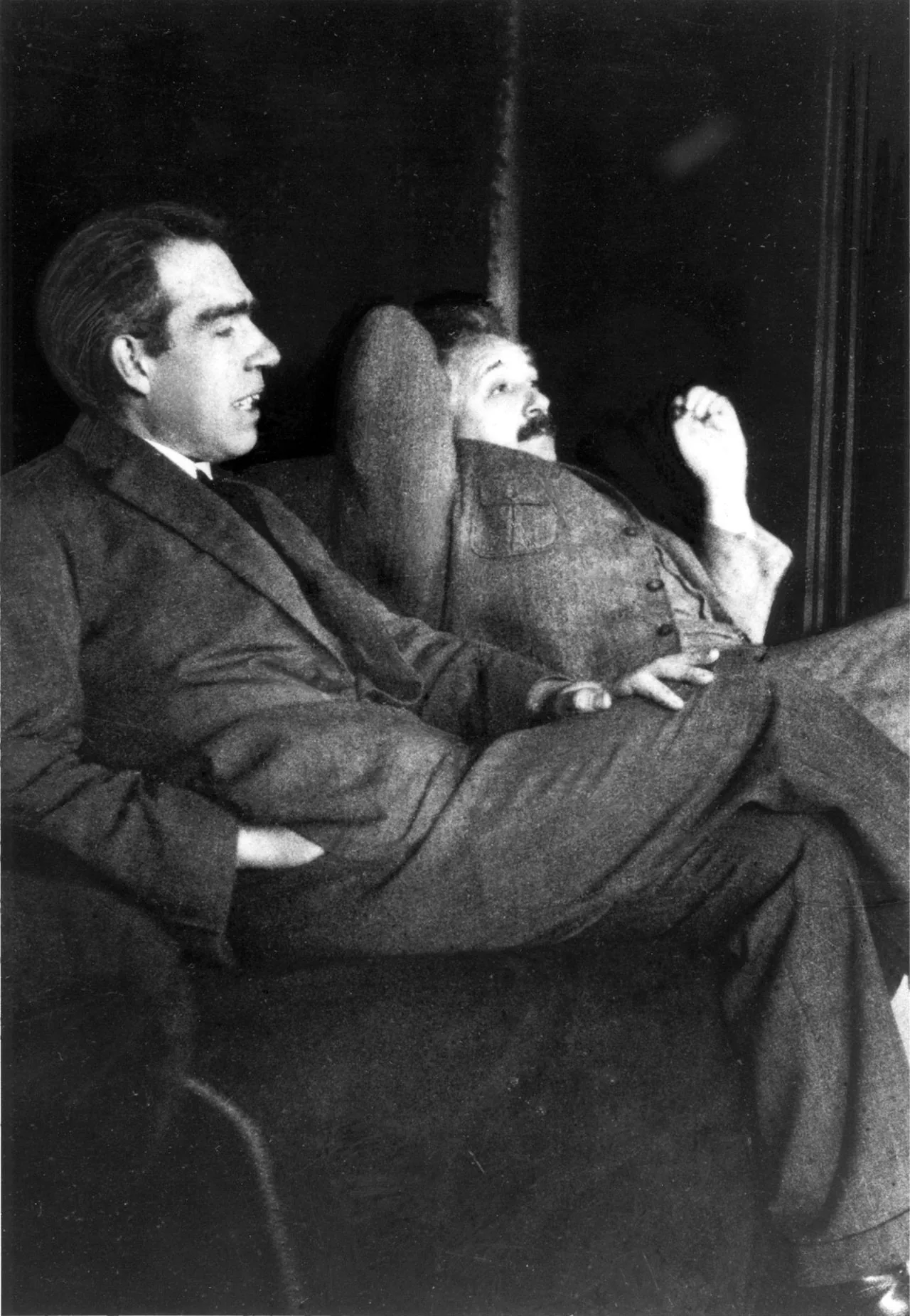
Niels Bohr and Albert Einstein sitting together, Bohr talking, Einstein listening
Niels Bohr and Albert Einstein, photographed by Paul Ehrenfest at his home in Leiden, probably in December 1925.Image: Paul Ehrenfest. Public domain, via Wikimedia Commons (Source)

In the rounds of 1927 and 1930 Bohr's defence held, and Einstein accepted it: afterwards he no longer attacked the consistency of quantum mechanics, but its completeness.

With EPR the matter is subtler. The experiments show that a world in which every particle carries its measurement values with it, fixed in advance, and in which no influence travels faster than light (“local hidden variables”) does not exist. That is exactly the picture Einstein hoped for. At the same time, entanglement cannot be used to send a message faster than light – Einstein's theory of relativity remains intact.

Einstein did not refute quantum theory with his objections, but he sharpened it. Entanglement, which he took as a sign of incompleteness and in 1947, in a letter to Max Born, called “spooky actions at a distance” (spukhafte Fernwirkungen), is today a key resource for quantum computers and some schemes of quantum cryptography. How quantum mechanics should be interpreted is still debated among physicists – only Einstein's local reality, fixed in advance, has been ruled out.

If, without in any way disturbing a system, we can predict with certainty (i.e., with probability equal to unity) the value of a physical quantity, then there exists an element of physical reality corresponding to this physical quantity.Einstein, Podolsky, RosenA. Einstein, B. Podolsky, N. Rosen, Physical Review 47 (1935), p. 777