Time dilation
Moving (or gravitationally lower) clocks tick more slowly than stationary ones.
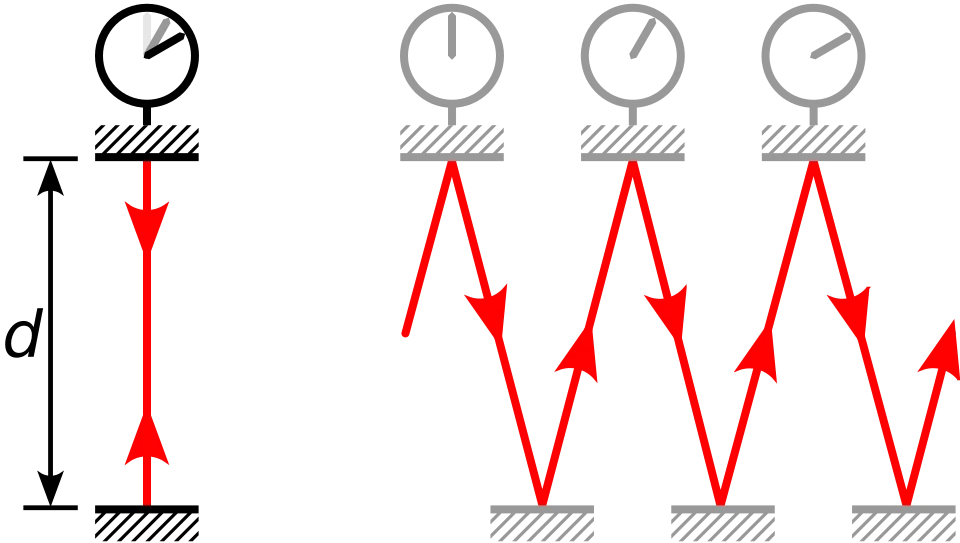
Time dilation is the slowing of time for a clock moving relative to an observer, by the Lorentz factor γ = 1/√(1−v²/c²). At everyday speeds it is negligible; near the speed of light it becomes dramatic — the root of the famous twin paradox. General relativity adds a second kind: clocks deeper in a gravitational field also tick more slowly.
Both are routinely confirmed: fast-moving particles live longer, atomic clocks flown around the world in 1971 (Hafele–Keating) disagreed by the predicted amounts, and GPS has to allow for both every day — taken together, the satellite clocks run fast by about 38 microseconds a day.
Source: Wikipedia: Time dilation — Read the full article on Wikipedia.