Quantum entanglement
Linked particles whose measurements stay correlated however far apart — Einstein's “spooky action.”
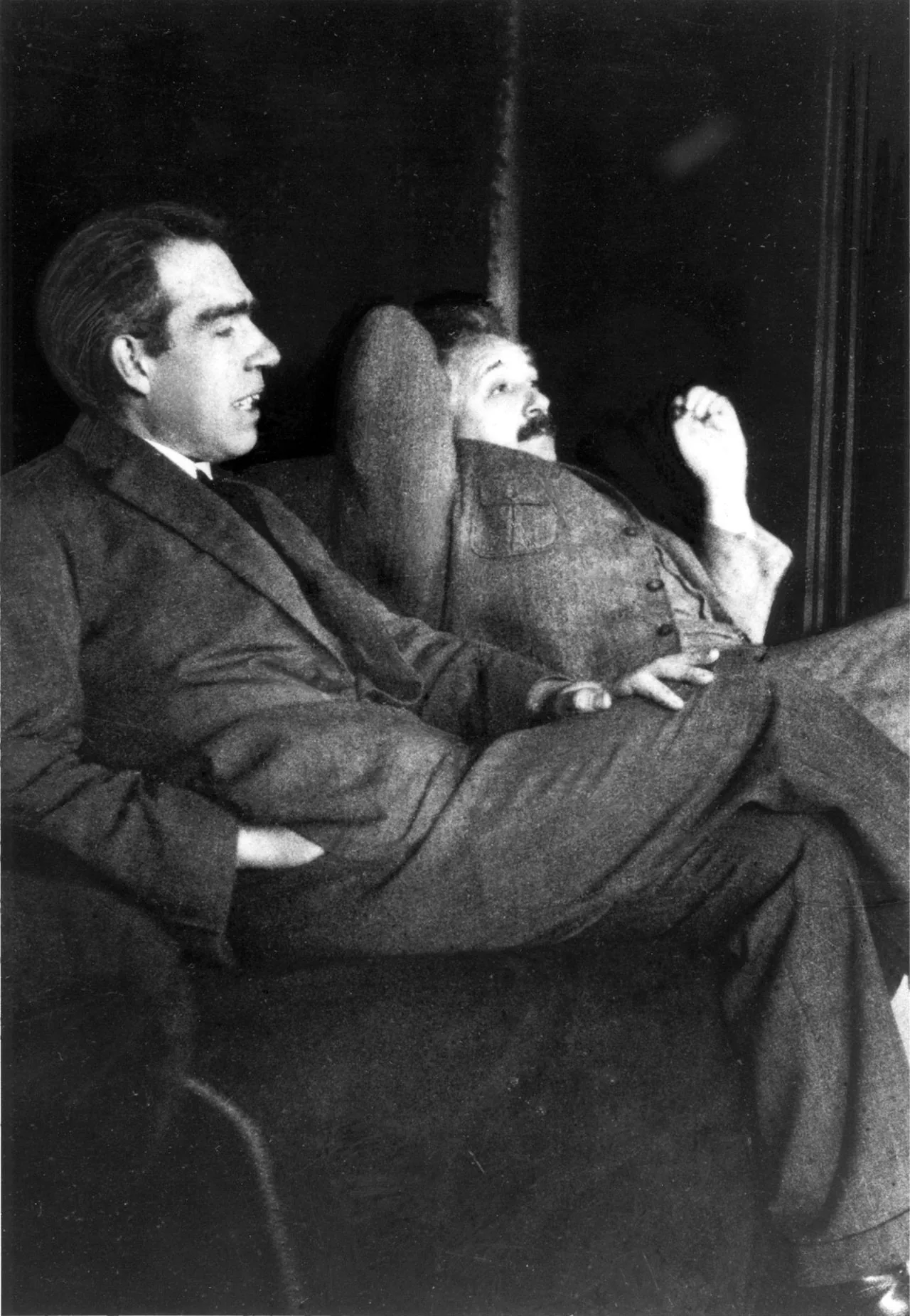
When two particles become entangled, their measured properties stay correlated, no matter how far apart they are — although this cannot be used to send signals faster than light. Einstein, Podolsky and Rosen highlighted the effect in 1935 to argue quantum theory was incomplete; the name “entanglement” was coined by Erwin Schrödinger the same year, and Einstein later (1947) called it “spooky action at a distance.”
Building on John Bell's theorem of 1964, experiments since the 1970s have confirmed that entanglement is real; Alain Aspect, John Clauser and Anton Zeilinger received the 2022 Nobel Prize in Physics for them. Today it is a resource for quantum computing and cryptography.