Earth twists spacetime — now measured to 0.2 percent
On 8 July 2026 a team reported in Nature the most precise measurement yet of frame dragging around the Earth: laser ranging to the satellites LARES-2 and LAGEOS matches Einstein’s prediction to about 0.2 percent.
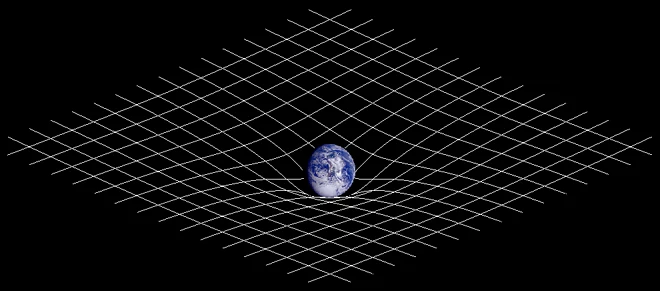
General relativity predicts that a rotating mass does not merely curve spacetime — it also drags it around as it turns. This is the Lense-Thirring effect, or frame dragging, modelled in 1918. Around a black hole it is dramatic; around a planet as light and as slowly spinning as the Earth it is minute, and shows up only as an extremely slow drift of a satellite’s orbital plane.
Writing in Nature on 8 July 2026, a team led by Ignazio Ciufolini reported the most accurate measurement of that terrestrial drift so far. Its centrepiece is LARES-2, a solid metal sphere of nearly 295 kilograms and a little over 40 centimetres across, covered with 303 retroreflectors and placed in orbit by the Italian Space Agency in July 2022; ground stations fire laser pulses at it and fix its position to about a millimetre. Because the Earth’s equatorial bulge disturbs any orbit far more strongly than relativity does, LARES-2 was paired with NASA’s LAGEOS satellite of 1976 on a supplementary orbit — the two inclinations add up to roughly 180 degrees, so the classical disturbance cancels between the two orbital planes while the relativistic one adds up. From some 200,000 laser measurements taken between July 2022 and June 2025, and after removing the tidal tug of Moon and Sun, the combined planes drift by about 61.3 milliarcseconds per year — Einstein’s value, now with an uncertainty near 0.2 percent instead of a few percent, roughly an order of magnitude tighter than earlier tests in the Solar System. That leaves noticeably less room for proposed alternatives to general relativity such as Chern-Simons gravity.