A falling quantum wave obeys Einstein’s ‘happiest thought’
On 2 September 2026 a team reported in Science Advances the first measurement of the quantum phase that a freely falling object acquires: one half of an atomic wave packet was allowed to fall while the other was held in place, and the phase between them matches the value expected from the equivalence principle to about 2.5 percent.
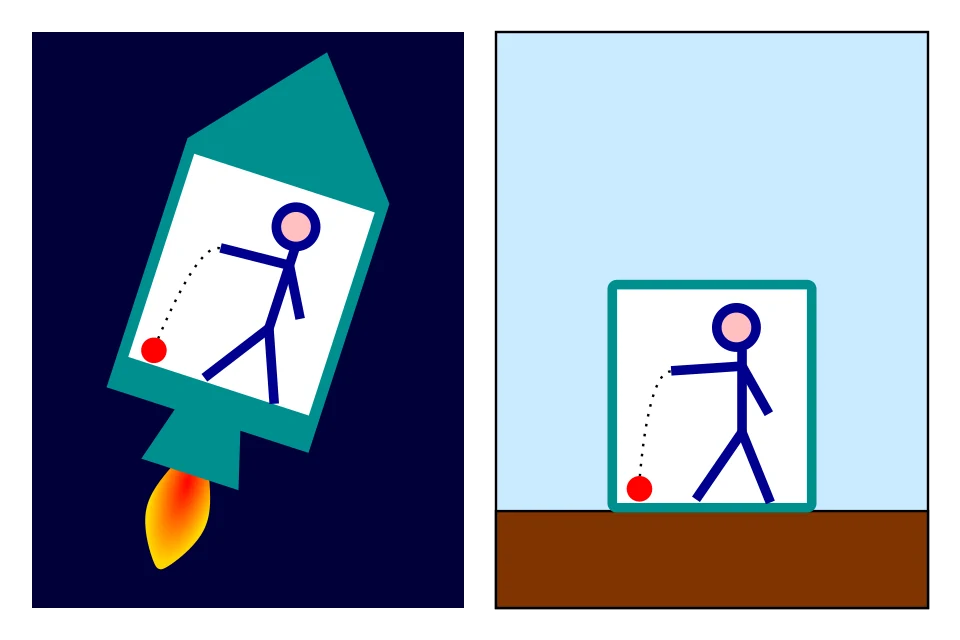
Einstein’s equivalence principle — the realisation he later called the happiest thought of his life — holds that a freely falling observer cannot locally tell gravity from acceleration. For large bodies it has been confirmed to extraordinary accuracy, but in quantum theory it takes a particular form: the wave associated with a falling object should acquire a phase that grows with the cube of the fall time. That prediction goes back to Charles Galton Darwin and Earle Kennard in 1927 — and had never been measured.
A team led by Ron Folman at Ben-Gurion University of the Negev, working with colleagues in Ulm and Oxford (the author list includes Roger Penrose, Vlatko Vedral and Wolfgang P. Schleich), built a cold-atom interferometer they call the Quantum Galileo Interferometer. About 20,000 rubidium atoms were cooled into a Bose-Einstein condensate in a magnetic trap on an atom chip and placed in a superposition of two internal states. One wave packet stayed magnetically held roughly 113 micrometres below the chip surface; the other was made insensitive to the field and flew ballistically, rising and falling under gravity alone and separating by about 7.5 micrometres at the top of its arc. After 2.4 milliseconds the two paths were recombined and their relative phase read from the interference pattern.
Across 633 experimental cycles taken over 5.3 hours, the phase ran through 13 full oscillations spanning some 80 radians and departed from the prediction — which has no free parameters — by about 2 radians, a deviation of roughly 2.5 percent. The same phase can be derived in two quite different ways: by treating gravity as a force acting on the quantum wave, or by stepping into the falling frame in which gravity disappears. That both routes give the same answer is what makes the measurement a test of the equivalence principle in the quantum domain. The authors are explicit about the limits: the result does not show that gravity itself is quantum, it does not unify the two theories, and it stays well short of the masses and timescales at which Penrose expects quantum mechanics to break down.